link1s.site

ChatGPT: Explained to Kids(How ChatGPT works)

Chat means chat, and GPT is the acronym for Gene Rate Pre trained Transformer.

Genrative means generation, and its function is to create or produce something new; Pre trained refers to a model of artificial intelligence that is learned from a large amount of textual materials, while Transformer refers to a model of artificial intelligence.

Don't worry about T, just focus on the words G and P.

We mainly use its Generative function to generate various types of content; But we need to know why it can produce various types of content, and the reason lies in P.

Only by learning a large amount of content can we proceed with reproduction.

And this kind of learning actually has limitations, which is very natural. For example, if you have learned a lot of knowledge since childhood, can you guarantee that your answer to a question is completely correct?

Almost impossible, firstly due to the limitations of knowledge, ChatGPT is no exception, as it is impossible to master all knowledge; The second is the accuracy of knowledge, how to ensure that all knowledge is accurate and error free; The third aspect is the complexity of knowledge, where the same concept is manifested differently in different contexts, making it difficult for even humans to grasp it perfectly, let alone AI.

So when we use ChatGPT, we also need to monitor the accuracy of the output content of ChatGPT. It is likely not a problem, but if you want to use it on critical issues, you will need to manually review it again.

And now ChatGPT has actually been upgraded twice, one is GPT4 with more accurate answering ability, and the other is the recent GPT Turbo.

The current ChatGPT is a large model called multimodality, which differs from the first generation in that it can not only receive and output text, but also other types of input, such as images, documents, videos, etc. The output is also more diverse. In addition to text, it can also output images or files, and so on.

Amid rising regional tensions, the US announced that it will hold another Rim of the Pacific military exercise
The U.S. Navy's Pacific Fleet announced on Wednesday (May 22) that the 2024 Rim of the Pacific Exercise (RIMPAC 2024) is expected to take place on June 26, with 29 countries participating in and around the Hawaiian Islands, a larger lineup than the previous exercise in 2022. The Philippines, which has had multiple maritime conflicts with China recently, and Japan, which has tense diplomatic relations with China, will send troops to participate. China has been excluded from participating in the international military exercise since 2018, and its aggressive actions and reactions are causing tensions in the Pacific region to continue to rise. The biennial Rim of the Pacific military exercise is the world's largest international maritime exercise. The U.S. Navy said that the exercise will last until August 2, and it is expected to involve 29 countries, 40 surface ships, 3 submarines, 14 countries' army forces, more than 150 aircraft and more than 25,000 personnel. The U.S. Navy said that the theme of the 29th RIMPAC 2024 is "Partners: Integrated and Ready", emphasizing inclusiveness as the core, promoting multinational cooperation and trust, and using military interoperability to achieve their respective national goals to strengthen integrated and ready alliance partners. Its goal is to "enhance collective strength and promote a free and open Indo-Pacific region" through joint training and operations. The 29 countries participating in the exercise this year include Australia, Belgium, Brazil, Brunei, Canada, Chile, Colombia, Denmark, Ecuador, France, Germany, India, Indonesia, Israel, Italy, Japan, Malaysia, Mexico, the Netherlands, New Zealand, Peru, South Korea, the Philippines, Singapore, Sri Lanka, Thailand, Tonga, the United Kingdom and the United States. Compared with the 28th RIMPAC held in 2022, which involved 26 countries, 38 surface ships, 4 submarines, 9 countries' army forces, more than 170 aircraft, and about 25,000 officers and soldiers, the number of countries, ships and army forces participating in this exercise has increased. The countries participating in this year's RIMPAC military exercise include all members of the Quadrilateral Security Dialogue (QUAD) between the United States, Japan, India and Australia, and the Australia-UK-US Trilateral Security Partnership (AUKUS), as in the previous exercise. In addition, countries surrounding the South China Sea and the South Pacific island nation of Tonga are also participating. Many analysts believe that the military exercise itself is sending a message to China: China's expansion in the Western Pacific region will be blocked and defeated. The United States invited China to participate in the RIMPAC military exercise twice in 2014 and 2016. In 2018, due to China's expansion in the South China Sea, the United States withdrew its invitation to China. In addition, despite Taiwan's repeated willingness to participate, Taiwan is still not included in the 29 countries participating in this year's RIMPAC military exercise. Analysts pointed out that the US-led RIMPAC military exercise is intended to unite allies to militarily intimidate China. If Taiwan is invited to join, it will be too provocative to China, which will not only aggravate the tension between the United States and China, but also embarrass some allies. The U.S. Navy said the commander of the U.S. Third Fleet will serve as the commander of the joint task force for the exercise, while Chilean Navy Commodore Alberto Guerrero will serve as deputy commander of the joint task force, which is a first in the history of the RIMPAC military exercise. In addition, Japan Maritime Self-Defense Force Rear Admiral Kazushi Yokota will also serve as deputy commander. Other key leaders of the multinational force exercise include Canadian Commodore Kristjan Monaghan, who will command the maritime forces, and Australian Air Force Commodore Louise Desjardins, who will command the air forces. According to the U.S. Stars and Stripes, Vice Admiral Michael Boyle is currently the commander of the U.S. Third Fleet. Vice Admiral John Wade has been nominated to replace Boyle. The U.S. Navy press release said the exercise will enhance the ability of international joint forces to "deter and defeat aggression by major powers in all domains and conflict levels," but did not provide specific information on which exercises will be held this summer. Previous RIMPAC training exercises have included sinking ships at sea with missiles, amphibious landings and the first landing of a Marine Corps Osprey aircraft on an Australian ship.
Are US development jobs falling off a cliff?
Companies are going to have fewer people and fewer layers. Ten years from now, the software development circuit may have fewer jobs, higher salaries, and more product-centric work. The reason behind it is the rapid development of AI, AI has approached human beings at the intelligence level, a lot of work relying on thinking ability may be handed over to AI, while emotion is still the territory of human beings, how to communicate and collaborate is the most important ability in the near future. When Indeed's chart for software development and operations jobs was released, we found that, as the chart shows, there was a peak in early 2022, but after that there was a precipitous decline.
How China can transform from passive to active amid US chip curbs
On Monday, executives from the three major chip giants in the US - Intel, Qualcomm, and Nvidia - met with US officials, including Antony Blinken, to voice their opposition to the Biden administration's plan of imposing further restrictions on chip sales to Chinese companies and investments in China. The Semiconductor Industry Association also released a similar statement, opposing the exclusion of US semiconductor companies from the Chinese market. First of all, we mustn't believe that the appeals of these companies and industry associations will collectively change the determination of US political elites to stifle China's progress. These US elites are very fearful of China's rapid development, and they see "chip chokehold" as a new discovery and a successful tactic formed under US leadership and with the cooperation of allies. Currently, the chip industry is the most complex technology in human history, with only a few companies being at the forefront. They are mainly from the Netherlands, Taiwan island, South Korea, and Japan, most of which are in the Western Pacific. These countries and regions are heavily influenced by the US. Although these companies have their own expertise, they still use some American technologies in their products. Therefore, Washington quickly persuaded them to form an alliance to collectively prevent the Chinese mainland from obtaining chips and manufacturing technology. Washington is proud of this and wants to continuously tighten the noose on China. The New York Times directly titled an article "'An Act of War': Inside America's Silicon Blockade Against China, " in which an American AI expert, Gregory Allen, publicly claimed that this is an act of war against China. He further stated that there are two dates that will echo in history from 2022: The first is February 24, when the Russia-Ukraine conflict broke out, and the second is October 7, when the US imposed a sweeping set of export controls on selling microchips to China. China must abandon its illusions and launch a challenging and effective counterattack. We already have the capability to produce 28nm chips, and we can use "small chip" technology to assemble small semiconductors into a more powerful "brain," exploring 14nm or even 7nm. Additionally, China is the world's largest commercial market for commodity semiconductors. Last year, semiconductor procurement in China amounted to $180 billion, surpassing one-third of the global total. In the past, China had been faced with the choice between independent innovation and external purchases. Due to the high returns from external purchases, it is easy for it to become the overwhelming choice over independent research and development. However, now the US is gradually blocking the option of external purchases, and China has no strategic choice but to independently innovate, which in turn puts tremendous pressure on American companies. Scientists generally expect that, although China may take some detours, such as recently apprehending several company leaders who fraudulently obtained subsidies from national semiconductor policies, China has the ability to gradually overcome the chip difficulties. And we will form our own breakthroughs and industrial chain, which is expected to put quite a lot of pressure on US companies. If domestic firms acquire half of China's $180 billion per year in chip acquisitions, this would provide a significant boost for the industry as a whole and help it advance steadily. The New York Times refers to the battle on chips as a bet by Washington. "If the controls are successful, they could handicap China for a generation; if they fail, they may backfire spectacularly, hastening the very future the United States is trying desperately to avoid," it argued. Whether it is a war or a game, when the future is uncertain, what US companies hope for most of all is that they can sell simplified versions of high-end chips to China, so that the option of external purchases by China continues to exist and remains attractive. This can not only maintain the interests of the US companies, enabling them to obtain sufficient funds to develop more advanced technologies, but also disrupt China's plans for independent innovation. This idea is entirely based on their own commercial interests and also has a certain political and national strategic appeal. Hence, there is no shortage of supporters within the US government. US Secretary of the Treasury Janet Yellen seems to be one of them, as she has repeatedly stated that the US' restrictions on China will not "fundamentally" hurt China, but will only be "narrowly targeted." The US will balance its strict suppression on China from the perspective of maintaining its technological hegemony, while also leaving some room for China, in order to undermine China's determination to counterattack in terms of independent innovation. China needs to use this mentality of the US to its advantage. On the one hand, China should continue to purchase US chips to maintain its economic fundamentals, and on the other hand, it should firmly support the development of domestic semiconductor companies from both financial and market perspectives. If China were to continue relying on exploiting the gaps in US chip policies in the long term, akin to a dependency on opium, it would only serve to weaken China further as it becomes increasingly addicted. China's market is extremely vast, and its innovation capabilities are generally improving and expanding. Although the chip industry is highly advanced, if there is one country that can win this counterattack, it is China. As long as we resolutely continue on the path of independent innovation, this road will definitely become wider. Various breakthroughs and turning points that are unimaginable today may soon occur.
Gold, silver caught in downdraft of broad commodity market sell off
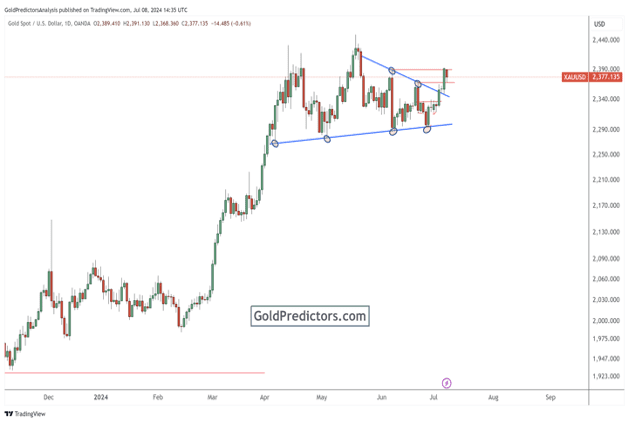
(Kitco News) - Gold and silver prices are sharply lower in midday U.S. trading Monday, on heavy profit-taking from the shorter-term futures traders after recent good price advances. The selling pressure today across most of the raw commodity spectrum is also keeping the precious metals bulls on the sidelines to start the trading week. August gold was last down $37.50 at $2,360.10. September silver was down $0.849 at $30.85. U.S. stock indexes mixed but near their record highs scored last week. The rallying stock market is a bearish element for the gold and silver markets, from a competing asset class perspective. The key U.S. data points of the week include Fed Chairman Powell’s speeches to the U.S. Congress on Tuesday and Wednesday, and the consumer and producer price indexes on Thursday and Friday, respectively. The key outside markets today see the U.S. dollar index slightly higher. Nymex crude oil prices are lower and trading around $82.25 a barrel. The benchmark 10-year U.S. Treasury note yield is presently 4.288%. Technically, August gold bulls have the overall near-term technical advantage. Bulls’ next upside price objective is to produce a close above solid resistance at the June high of $2,406.70. Bears' next near-term downside price objective is pushing futures prices below solid technical support at $2,300.00. First resistance is seen at $2,382.60 and then at $2,400070. First support is seen at $2,350.00 and then at last week’s low of $2,327.40. Wyckoff's Market Rating: 6.0. September silver futures bulls have the overall near-term technical advantage. Silver bulls' next upside price objective is closing prices above solid technical resistance at the May high of $33.05. The next downside price objective for the bears is closing prices below solid support at the June low of $28.90. First resistance is seen at $31.00 and then at $31.50. Next support is seen at Friday’s low of $30.45 and then at $30.00. Wyckoff's Market Rating: 6.5. (Hey! My “Markets Front Burner” weekly email report is my best writing and analysis, I think, because I get to look ahead at the marketplace and do some market price forecasting. Plus, I’ll throw in an educational feature to move you up the ladder of trading/investing success. And it’s free! Email me at jim@jimwyckoff.com and I’ll add your email address to my Front Burner list.)
BRI: embracing Chinese green practices for a sustainable future
Editor's Note: This year marks the 10th anniversary of the Belt and Road Initiative (BRI) proposed by Chinese President Xi Jinping. Through the lens of foreign pundits, we take a look at 10 years of the BRI - how it achieves win-win cooperation between China and participating countries of the BRI and how it has given the people of these countries a sense of fulfillment. In an interview with Global Times (GT) reporter Li Aixin, Erik Solheim (Solheim), former under-secretary-general of the United Nations and former executive director of the UN Environment Programme, recalled how the BRI helped shorten a previously long journey in Sri Lanka to a half-hour trip. "We will all be losers in a de-globalized, de-coupled world. The BRI can play a key role in bringing the world together," Solheim said. This is the 18th piece of the series. GT: How do you evaluate the role of the BRI in promoting development in participating countries over the past 10 years? Solheim: The BRI has been a major driver of development since it was announced by President Xi Jinping in Kazakhstan 10 years ago. The China-Laos Railway has connected landlocked Laos to the Chinese and European rail network, making it possible for Laos to sell more goods and welcome more tourists. Rail corridors in Kenya and from Djibouti to Addis Ababa connect the interior of Africa to the coast, bringing opportunities for much faster development in East Africa. The Bandung-Jakarta railway in Indonesia, Hanoi metro, roads and ports in Sri Lanka - there are great examples of good south-south and BRI projects in almost every corner of the world. GT: In your experience of traveling around the world, has any BRI-related story left a deep impression on you? Solheim: Yes, many! I'll just mention two. When I was chief negotiator in the Sri Lanka peace process 15 years ago, it took a long time to travel from the airport to Colombo, the capital of Sri Lanka. When I came back last year, it took half an hour on wonderful Chinese-built highways. Traveling through Mombasa, a coastal city in Kenya, you see a lot of poverty and run down houses. Then all of a sudden, a green, clean, well-run oasis opens up. It's the end station of the Nairobi-Mombasa railway which links the capital Nairobi to the coast. The rail station stands out and is showing the future for Kenya. GT: The EU proposed the Global Gateway, and the US proposed the Build Back Better World. What do you think are the similarities and differences between these projects and the BRI? Solheim: I really wish success for the Western initiatives. What developing nations ask for is a choice of good cooperation with both China and the West. Unfortunately, up to now, a number of the Western-led initiatives have been more like media events. They lack structure, secretariat, finances and clear direction. Nearly all nations in the world want to see close people-to-people relations, investment and political cooperation with both China and the West. No one wants to choose. GT: Some people from the West are talking about "de-coupling" and "de-risking." Both seem to be another way of saying "de-globalization." Do you think "de-coupling" and "de-risking" will affect the BRI? And what role will the BRI play in maintaining globalization? Solheim: Decoupling is probably the most unwise idea in the world today. It's outright dangerous. Facing climate change, environmental degradation, economic troubles, war in Ukraine and other places, and the threat of pandemics, we need more, not less, cooperation. We will all be losers in a de-globalized, de-coupled world. The BRI can play a key role in bringing the world together. Almost all developing countries have made BRI agreements with China. As an example, when President Xi met all the leaders of Central Asia recently in Xi'an, Northwest China's Shaanxi Province, they made a very ambitious declaration on future green cooperation between China and Central Asia. GT: You have previously said that the BRI is a fantastic vehicle to promote green global development, which can boost the economy and ecology at the same time. Could you elaborate on how you think the BRI has achieved development of the economy and ecology? Solheim: In the beginning there were too many fossil fuel projects among BRI programs. In the BRI International Green Development Coalition, we argued this should stop. When President Xi pledged to stop building new coal-fired power projects overseas, it was one of the most important environmental decisions ever. Also, it happened at a time when important BRI nations like Bangladesh, Kenya and Pakistan decided they could grow their economies and go green without coal. The BRI will in the next decade become the world's most important vehicle for green energy and green transport. We will see massive investments in solar and wind power, hydrogen, electric batteries and more. GT: How do you view China's goal of achieving harmony between humanity and nature in modernization? In what way is China's story in pursuing harmony between humanity and nature relevant to other countries? Solheim: China now covers between 60 percent and 80 percent of all major green technologies in the world - solar, wind, hydro, batteries, electric cars and high-speed rail. Companies like Longi, BYD and CATL are the world leaders in their sectors. More remarkably and maybe less noticed abroad, China is also a global leader in protecting nature. It's embarking upon one of the most massive national park programs, with a focus on Qinghai Province and Xizang Autonomous Region. China is by far the biggest tree planter in the world and the global leader in desert control in Kubuqi, Inner Mongolia and other places. China has been hugely successful in the recovery of endangered species like the Giant Panda, Tibetan Antelope and Snow Leopard. A new center for mangrove restoration is being set up in Shenzhen and the fishing ban in the Yangtze will restore that magnificent ecosystem. The Belt and Road is a great opportunity for the world to learn from good Chinese green practices.