Are US development jobs falling off a cliff?
Companies are going to have fewer people and fewer layers. Ten years from now, the software development circuit may have fewer jobs, higher salaries, and more product-centric work.
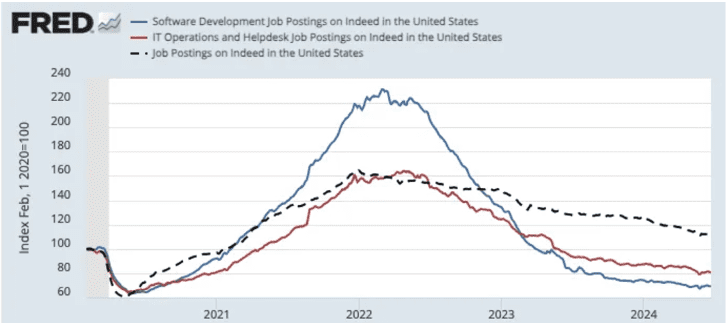
The reason behind it is the rapid development of AI, AI has approached human beings at the intelligence level, a lot of work relying on thinking ability may be handed over to AI, while emotion is still the territory of human beings, how to communicate and collaborate is the most important ability in the near future. When Indeed's chart for software development and operations jobs was released, we found that, as the chart shows, there was a peak in early 2022, but after that there was a precipitous decline.
Wto: Members have more trade promotion measures than restrictions
The latest trade monitor released recently by the World Trade Organization shows that between mid-October 2023 and mid-May 2024, WTO members continued to introduce more trade promotion measures than trade restrictive measures. The WTO said it was an important signal of members' commitment to keep trade flowing amid the current geopolitical uncertainty. According to WTO statistics, during the monitoring period, WTO members adopted 169 trade promotion measures on commodities, more than the 99 trade restrictive measures introduced. Most of the measures are aimed at imports. Commenting on the findings, WTO Director-General Ngozi Okonjo-Iweala said that despite the challenging geopolitical environment, this latest trade monitoring report highlights the resilience of world trade. Even against the backdrop of rising protectionist pressures and signs of economic fragmentation, governments around the world are taking meaningful steps to liberalize and boost trade. This demonstrates the benefits of trade on people's purchasing power, business competitiveness and price stability. The WTO monitoring also identified significant new developments in economic support measures. Subsidies as part of industrial policy are increasing rapidly, especially in areas related to climate change and national security.

Israeli strike kills a senior Hezbollah commander in south Lebanon
BEIRUT/JERUSALEM July 3 (Reuters) - An Israeli strike killed one of Hezbollah's top commanders in south Lebanon on Wednesday, prompting retaliatory rocket fire by the Iran-backed group into Israel as their dangerously poised conflict rumbled on. The Israeli military said it had struck and eliminated Hezbollah's Mohammed Nasser, calling him commander of a unit responsible for firing from southwestern Lebanon at Israel. Nasser, killed by an airstrike near the city of Tyre in southern Lebanon, was the one of the most senior Hezbollah commanders to die yet in the conflict, two security sources in Lebanon said. Sparked by the Gaza war, the hostilities have raised concerns about a wider and ruinous conflict between the heavily armed adversaries, prompting U.S. diplomatic efforts aimed at deescalation. Israeli Defence Minister Yoav Gallant said Israeli forces were hitting Hezbollah "very hard every day" and will be ready to take any action necessary against the group, though the preference is to reach a negotiated arrangement. Hezbollah began firing at Israeli targets at the border after its Palestinian ally Hamas launched the Oct. 7 attack on Israel, declaring support for the Palestinians and saying it would cease fire when Israel stops its Gaza offensive. Hezbollah announced at least two attacks in response to what it called "the assassination", saying it launched 100 Katyusha rockets at an Israeli military base and its Iranian-made Falaq missiles at another base in the town of Kiryat Shmona near the Israeli-Lebanese border. Israel's Channel 12 broadcaster reported that dozens of rockets were fired into northern Israel from Lebanon. There were no reports of casualties. The Israeli Defence Ministry said that air raid sirens sounded in several parts of northern Israel. Israel's military did not give a number of rockets launched but said most of them fell in open areas, some were intercepted, while a number of launches fell in the area of Kiryat Shmona.

Australia pledges to provide more funds to Pacific island banks to counter China's influence
Australia pledged on Tuesday to increase investment in Pacific island nations, offering A$6.3 million ($4.3 million) to support their financial systems. Some Western banks are cutting ties with the region because of risk factors, while China is trying to increase its influence there. Some Western bankers have terminated long-standing banking relationships with small Pacific nations, while others are considering closing operations and restricting access to dollar-denominated bank accounts in those countries. "We know that the Pacific is the fastest-moving region in the world for correspondent banking services," Australian Treasurer Jim Chalmers said in a speech at the Pacific Banking Forum in Brisbane. "What's at stake here is the Pacific's ability to engage with the world," he said, with much of the region at risk of being cut off from the global financial system. Chalmers said Australia would provide A$6.3 million ($4.3 million) to the Pacific to develop secure digital identity infrastructure and strengthen compliance with anti-money laundering and counter-terrorist financing requirements. Experts say Western banks are de-risking to meet financial regulations, making it harder for them to do business in Pacific island nations, where compliance standards sometimes lag, undermining their financial resilience. Australia's ANZ Bank is in talks with governments about how to make its Pacific island businesses more profitable amid concerns about rising Chinese influence as financial services leave the West, Chief Executive Shayne Elliott said Tuesday. ANZ is the largest bank in the Pacific region, with operations in nine countries, though some of those businesses are not financially sustainable, Elliott said in an interview on the sidelines of the forum. "If we were there purely for commercial purposes, we would have closed it a long time ago," he said. Western countries, which have traditionally dominated the Pacific, are increasingly concerned about China's plans to expand its influence in the region after it signed several major defense, trade and financial agreements with the region. Bank of China signed an agreement with Nauru this year to explore opportunities in the country, following Australia's Bendigo Bank saying it would withdraw from the country. Mr. Chalmers said Australia was working with Nauru to ensure that banking services in the country could continue. ANZ Bank exited its retail business in Papua New Guinea in recent years, while Westpac considered selling its operations in Fiji and Papua New Guinea but decided to keep them. The Pacific lost about 80% of its correspondent banking relationships for dollar-denominated services between 2011 and 2022, Australian Assistant Treasurer Stephen Jones told the forum, which was co-hosted by Australia and the United States. “We would be very concerned if there were countries acting in the region whose primary objective was to advance their own national interests rather than the interests of Pacific island countries,” Mr. Jones said on the first day of the forum in Brisbane. He made the comment when asked about Chinese banks filling a vacuum in the Pacific. Meanwhile, Washington is stepping up efforts to support Pacific island countries in limiting Chinese influence. "We recognize the economic and strategic importance of the Pacific region, and we are committed to deepening engagement and cooperation with our allies and partners to enhance financial connectivity, investment and integration," said Brian Nelson, U.S. Treasury Undersecretary for Counterterrorism and Financial Intelligence. The United States is aware of the problem of Western banks de-risking in the Pacific region and is committed to addressing it, Nelson told the forum's participants. He said data showed that the number of correspondent banking relationships in the Pacific region has declined at twice the global average rate over the past decade, and the World Bank and the Asian Development Bank are developing plans to improve correspondent banking relationships. U.S. Treasury Secretary Janet Yellen said in a video address to the forum on Monday (July 8) that the United States is focused on supporting economic resilience in the Pacific region, including by strengthening access to correspondent banks. She said that when President Biden and Australian Prime Minister Anthony Albanese met at the White House last year, they particularly emphasized the importance of increasing economic connectivity, development and opportunities in the Pacific region, and a key to achieving that goal is to ensure that people and businesses in the region have access to the global financial system.
Enhance Your Photos With NASA's Sharpening Technique
Incredible space photos like those from NASA don't look as stunning straight out of the telescope. They need significant processing, and a crucial part of that is sharpening. Coming to you from Unmesh Dinda with PiXimperfect, this fascinating video explores the APF-R plugin, developed by award-winning astrophotographer Christoph Kaltseis. APF-R stands for Absolute Point of Focus, and it's designed to enhance photo details without creating halos or artifacts. This technology has been used by space agencies with telescopes like the James Webb, and now, you can use it in Photoshop. The plugin allows for non-destructive editing, meaning you can adjust the radius and detail level without permanently altering your image. This feature is crucial for astrophotography, where preserving original details is vital. The video shows how APF-R compares to Photoshop's built-in sharpening tools. The plugin offers multiple rendering methods, each suited for different types of images. For instance, the "Center Weighted" method provides a balanced sharpening effect without making the image look overprocessed. Dinda explains how to fine-tune these settings to achieve the best results, making it clear why this plugin is a game-changer for photographers looking to enhance their images with precision. One notable feature of APF-R is its ability to work with different image types. The video demonstrates how the plugin enhances not just space photos but also landscapes and portraits. For portraits, APF-R can bring out skin textures and eye details without creating the unwanted halos that traditional sharpening methods often produce. Dinda also shows how to combine APF-R with other Photoshop tools, like Smart Sharpen, for even better results. This versatility makes APF-R a valuable addition to any photographer's toolkit. The plugin's cost is $50, which Dinda considers a bargain given its advanced capabilities. There's also a Creative Bundle subscription that includes APF-R and 20 other tools, offering great value for those looking to expand their editing options. Dinda provides discount codes in the video description, making this sophisticated tool more accessible. Check out the video above for the full rundown from Dinda.

Japan and the Philippines signed the "Reciprocal Access Agreement". Experts: Japan wants to use the Philippines to strategically contain China
Japan and the Philippines signed an important defense agreement, and the two sides became "quasi-allies". On July 8, local time, Japan and the Philippines signed the "Reciprocal Access Agreement" in Manila. The agreement will relax restrictions on the movement of personnel between the Japanese Self-Defense Forces and the Philippine military during joint exercises, mutual visits and other operations in each other's countries. In response, Chinese Foreign Ministry spokesman Lin Jian responded at a regular press conference on the 8th that exchanges and cooperation between countries should not undermine mutual understanding and trust between regional countries, should not undermine regional peace and stability, and should not target third parties or undermine the interests of third parties. The Asia-Pacific region does not need military groups, let alone "small circles" that provoke camp confrontation and instigate a "new Cold War". Any actions that undermine peace and stability in the region and undermine unity and cooperation in the region will arouse the vigilance and common opposition of the people in the region. Japan and the Philippines upgraded to a "quasi-alliance" relationship On the same day, a "2+2" meeting attended by the foreign ministers and defense ministers of Japan and the Philippines was held in Manila. Japanese Defense Minister Minoru Kihara and Foreign Minister Yoko Kamikawa attended the talks with Philippine Defense Minister Gilbert Teodoro and Foreign Minister Enrique Manalo. This is the second Japan-Philippines "2+2" meeting. The last one was held in Tokyo in April 2022. Witnessed by Philippine President Marcos, the two sides signed the "Reciprocal Access Agreement". Marcos expressed the hope that the bilateral relations between the Philippines and Japan and the trilateral cooperation between the Philippines, Japan and the United States will be further deepened. The "Reciprocal Access Agreement" is also known as the "Military Visits Agreement". Military and defense cooperation between sovereign states, especially sending troops into each other's territory, usually faces complicated procedures and other problems. In order to simplify the procedures, the two countries will reach relevant agreements to simplify the approval procedures for the entry of troops from both sides into each other's countries, and facilitate mutual visits and joint military activities between the two countries' troops. The "Reciprocal Access Agreement" was born. Take the "Reciprocal Access Agreement" signed by Japan and Australia (full name "Agreement between Japan and Australia on Promoting Mutual Access and Cooperation Facilitation between the Japanese Self-Defense Forces and the Australian Defense Force") as an example. The agreement has 29 articles, covering many areas such as entry and exit procedures for troops, jurisdiction, taxation, cost burden and compensation. The key is to simplify the entry and exit procedures for visiting troops and their members, ships, aircraft, etc., relax restrictions on the transportation of weapons, ammunition and materials carried by visiting troops, and provide a legal basis for the two countries' troops and weapons and equipment to enter each other's territory. Japan and the Philippines signed the "Reciprocal Access Agreement", making the Philippines the third country to conclude this agreement with Japan after Australia and the United Kingdom. Cai Liang, Secretary-General and Researcher of the China-Japan Relations Research Center of the Shanghai Institute for International Studies, analyzed to The Paper (www.thepaper.cn) that Japan and the Philippines have their own strategic considerations for signing the "Reciprocal Access Agreement". As for the Philippines, due to its limited strength, it does not exclude any foreign power willing to strengthen military cooperation with the Philippines from intervening in the South China Sea situation. Therefore, it can be seen that in the past two years, the Philippines has actively promoted Australia, France, India and other countries to intervene in the South China Sea and strengthen military cooperation with them, involving intelligence, weapons and equipment, and training and exercises. "Japan's purpose is very simple. Strengthening military cooperation with the Philippines is to strategically balance China. The United States and the Philippines are allies, and the US-Japan alliance has been upgraded to a 'quasi-alliance'. The military cooperation between the United States, Japan and the Philippines has been upgraded to a new level." Cai Liang said, "The signing of an important defense agreement between Japan and the Philippines will make it easier for Japan to intervene in the South China Sea situation and seek the 'three seas linkage' of the East China Sea, the South China Sea, and the Taiwan Strait, in order to better respond to China's strategy and enhance its international influence." As for whether the signing of the "Reciprocal Access Agreement" means that Japan will deploy the Self-Defense Forces in the Philippines, Cai Liang pointed out that this agreement only simplifies the procedures for the troops of both sides to enter each other's territory, and is more suitable for short-term training, military exercises, etc., and is not a long-term deployment of the Self-Defense Forces in the Philippines. The two countries deepen military cooperation The Philippine presidential office also said in a statement that Japan is one of the four major strategic partners of the Philippines, and the two countries have established a strategic partnership for more than ten years. It seems no coincidence that Japan and the Philippines signed the "Reciprocal Access Agreement" at this time. Recently, China-Philippines relations have become tense around the situation in the South China Sea. The Global Times quoted Japan's Kyodo News Agency as saying that the two sides are seeking to strengthen cooperation against China. Minoru Kihara said last week: "The Philippines is located in a strategically important region, occupies a key position on Japan's sea lanes, and is also an ally of the United States. Joint training and strengthening cooperation with the Philippines are of great significance to the realization of a 'free and open Indo-Pacific region'." Cai Liang said that Japan's intervention in the South China Sea situation is mainly to reduce strategic pressure in the East China Sea and southwest of Japan, but it is not conducive to peace and stability in the South China Sea. It is reported that Japan and the Philippines began negotiations on the agreement in November last year. The signing of the "Reciprocal Access Agreement" by the two sides lays the foundation for the two countries to strengthen bilateral and even multilateral military cooperation in the future. The Japanese government intends to allow the Self-Defense Forces to formally participate in the annual US-Philippines "Shoulder to Shoulder" joint exercises around the Philippines after the agreement comes into effect. The Self-Defense Forces previously participated in the "Shoulder to Shoulder" exercises as observers, and will be able to formally participate after signing the agreement. In April this year, the United States and the Philippines held the largest "Shoulder to Shoulder" exercise to date, involving 5,000 Philippine personnel and 11,000 US personnel. The military exercise also included about 150 Australian military personnel and 100 French naval personnel. According to the plan, 14 countries including Japan and India sent personnel as observers. The "Typhon" medium-range missile launch system deployed by the US military on Luzon Island in the Philippines for the first time participated in the exercise, which aroused great attention from all walks of life. In terms of weapons and equipment exports, Japan and the Philippines have gradually strengthened military cooperation in recent years. The Philippines recently agreed to purchase five Coast Guard patrol ships from Japan to enhance its patrol capabilities in the South China Sea. Defense News reported in November last year that the Philippines had received an early warning radar system from Japan in 2023, the first major equipment transfer since the Japanese government lifted the postwar defense export ban in 2014. The Japanese Ministry of Foreign Affairs stated that Kamikawa mentioned topics such as defense equipment transfer, "government security capability enhancement support" (OSA), and economic and trade cooperation. The OSA project was created by the Kishida government and plans to allocate billions of yen in budget to assist the military construction of the Philippines and other countries, including providing the Philippines with 5 sets of coastal surveillance radars. Regarding Japan's relaxation of restrictions on defense equipment exports, the Chinese Ministry of Defense previously responded that Japan has continuously broken through the constraints of the "peace constitution" and the principle of "exclusive defense", and has been making small moves in the field of military security, which has aroused high vigilance and strong concern from the international community. China requires Japan to deeply reflect on its history of aggression, attach importance to the security concerns of its Asian neighbors, adhere to the path of peaceful development, and win the trust of its Asian neighbors and the international community with practical actions.