Exclusive: India's Paytm gets government panel nod to invest in payments arm, sources say
NEW DELHI, July 9 (Reuters) - India's beleaguered Paytm (PAYT.NS), opens new tab has secured approval from a government panel that oversees investments linked to China to invest 500 million rupees ($6 million) in a key subsidiary, three sources with direct knowledge of the matter said. The approval, which still has to be vetted by the finance ministry, will remove the main stumbling block to the unit, Paytm Payment Services, resuming normal business operations. Paytm Payment Services is one of the biggest remaining parts of the fintech firm's business, accounting for a quarter of consolidated revenue in the financial year ended March 2023. A separate unit, Paytm Payments Bank, was wound down this year by order of the central bank due to persistent compliance issues, triggering a meltdown in Paytm's stock. The government panel had earlier held back approval due to concerns about the 9.88% stake in Paytm held by China's Ant Group. India has intensified scrutiny of Chinese businesses since a 2020 border clash between the two countries. All in all, Paytm has been waiting for the nod from the government panel for about two years and without it, it would have had to also wind down its payment services business, which was forbidden from taking on new customers in March 2023. Once the approval has been formalised, it will be able to seek a so-called "payment aggregator" licence from the Reserve Bank of India. The sources, two of whom are government sources, declined to be identified as the decision has not been formally announced. India's foreign, home, finance and industries ministries, whose representatives sit on the panel, did not reply to emails seeking comment. A Paytm spokesperson said the company does not comment on market speculation. "We will continue to make disclosures in compliance with our obligations under the SEBI Regulations, and will inform the exchanges when there is any new material information to share," the spokesperson said.
How China can transform from passive to active amid US chip curbs
On Monday, executives from the three major chip giants in the US - Intel, Qualcomm, and Nvidia - met with US officials, including Antony Blinken, to voice their opposition to the Biden administration's plan of imposing further restrictions on chip sales to Chinese companies and investments in China. The Semiconductor Industry Association also released a similar statement, opposing the exclusion of US semiconductor companies from the Chinese market. First of all, we mustn't believe that the appeals of these companies and industry associations will collectively change the determination of US political elites to stifle China's progress. These US elites are very fearful of China's rapid development, and they see "chip chokehold" as a new discovery and a successful tactic formed under US leadership and with the cooperation of allies. Currently, the chip industry is the most complex technology in human history, with only a few companies being at the forefront. They are mainly from the Netherlands, Taiwan island, South Korea, and Japan, most of which are in the Western Pacific. These countries and regions are heavily influenced by the US. Although these companies have their own expertise, they still use some American technologies in their products. Therefore, Washington quickly persuaded them to form an alliance to collectively prevent the Chinese mainland from obtaining chips and manufacturing technology. Washington is proud of this and wants to continuously tighten the noose on China. The New York Times directly titled an article "'An Act of War': Inside America's Silicon Blockade Against China, " in which an American AI expert, Gregory Allen, publicly claimed that this is an act of war against China. He further stated that there are two dates that will echo in history from 2022: The first is February 24, when the Russia-Ukraine conflict broke out, and the second is October 7, when the US imposed a sweeping set of export controls on selling microchips to China. China must abandon its illusions and launch a challenging and effective counterattack. We already have the capability to produce 28nm chips, and we can use "small chip" technology to assemble small semiconductors into a more powerful "brain," exploring 14nm or even 7nm. Additionally, China is the world's largest commercial market for commodity semiconductors. Last year, semiconductor procurement in China amounted to $180 billion, surpassing one-third of the global total. In the past, China had been faced with the choice between independent innovation and external purchases. Due to the high returns from external purchases, it is easy for it to become the overwhelming choice over independent research and development. However, now the US is gradually blocking the option of external purchases, and China has no strategic choice but to independently innovate, which in turn puts tremendous pressure on American companies. Scientists generally expect that, although China may take some detours, such as recently apprehending several company leaders who fraudulently obtained subsidies from national semiconductor policies, China has the ability to gradually overcome the chip difficulties. And we will form our own breakthroughs and industrial chain, which is expected to put quite a lot of pressure on US companies. If domestic firms acquire half of China's $180 billion per year in chip acquisitions, this would provide a significant boost for the industry as a whole and help it advance steadily. The New York Times refers to the battle on chips as a bet by Washington. "If the controls are successful, they could handicap China for a generation; if they fail, they may backfire spectacularly, hastening the very future the United States is trying desperately to avoid," it argued. Whether it is a war or a game, when the future is uncertain, what US companies hope for most of all is that they can sell simplified versions of high-end chips to China, so that the option of external purchases by China continues to exist and remains attractive. This can not only maintain the interests of the US companies, enabling them to obtain sufficient funds to develop more advanced technologies, but also disrupt China's plans for independent innovation. This idea is entirely based on their own commercial interests and also has a certain political and national strategic appeal. Hence, there is no shortage of supporters within the US government. US Secretary of the Treasury Janet Yellen seems to be one of them, as she has repeatedly stated that the US' restrictions on China will not "fundamentally" hurt China, but will only be "narrowly targeted." The US will balance its strict suppression on China from the perspective of maintaining its technological hegemony, while also leaving some room for China, in order to undermine China's determination to counterattack in terms of independent innovation. China needs to use this mentality of the US to its advantage. On the one hand, China should continue to purchase US chips to maintain its economic fundamentals, and on the other hand, it should firmly support the development of domestic semiconductor companies from both financial and market perspectives. If China were to continue relying on exploiting the gaps in US chip policies in the long term, akin to a dependency on opium, it would only serve to weaken China further as it becomes increasingly addicted. China's market is extremely vast, and its innovation capabilities are generally improving and expanding. Although the chip industry is highly advanced, if there is one country that can win this counterattack, it is China. As long as we resolutely continue on the path of independent innovation, this road will definitely become wider. Various breakthroughs and turning points that are unimaginable today may soon occur.
Kris Jenner Shares Plans to Remove Ovaries After Tumor Diagnosis
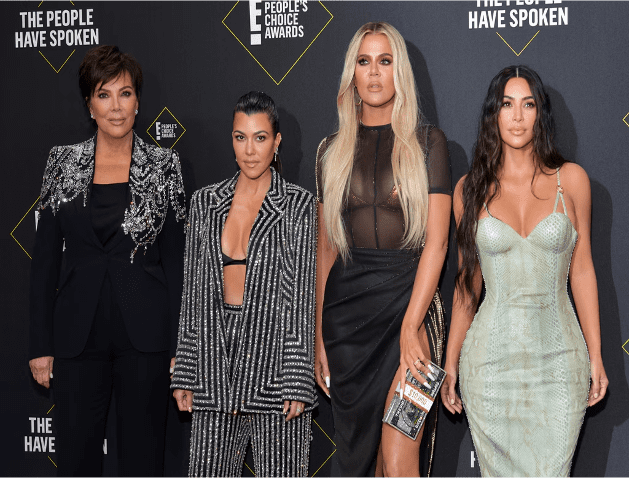
Kris Jenner is opening up about her health. The reality star shared plans to have her ovaries surgically removed after she was diagnosed with a tumor on one of the organs. “I went to the doctor and I had my scan," she tearfully told daughters Kim Kardashian, Khloe Kardashian and Kendall Jenner on the July 4 episode of The Kardashians. "They found a cyst.” Kris continued, "They said I gotta have my ovaries taken out." While the 68-year-old—who is also mom to kids Kourtney Kardashian, Rob Kardashian and Kylie Jenner—wasn't nervous about the procedure, she did feel very emotional over having to part with her ovaries because, as she put it, "that’s where all my kids were conceived." "It’s also a thing about getting older," Kris noted. "It’s a sign of 'we’re done with this part of your life.' It’s a whole chapter that’s just closed.” She added in a separate confessional, “People often ask me what is the best job you’ve ever had, and I always say mom. The biggest blessing in my life was being able to give birth to six beautiful kids.” And in true Kardashian fashion, Kris' family quickly rallied behind her. After Kourtney called in to check on Kris, the Poosh founder said in a confessional, "I totally understand how my mom is feeling because I would feel the same way." "It’s your womanly power," Kourtney continued. "It doesn’t mean it’s taking away who she is or what she’s experienced, but I would feel this sentimental feeling of what it’s created.” Likewise, Kim empathized with Kris, saying that she feels "really sad for her." "To have a surgery and remove your ovaries is a really big deal," the SKIMS mogul shared. "I couldn’t even imagine being in that situation.” Kris' longtime boyfriend Corey Gamble also showed his support, surprising the momager with a special gift to “help your energy."
Wto: Members have more trade promotion measures than restrictions
The latest trade monitor released recently by the World Trade Organization shows that between mid-October 2023 and mid-May 2024, WTO members continued to introduce more trade promotion measures than trade restrictive measures. The WTO said it was an important signal of members' commitment to keep trade flowing amid the current geopolitical uncertainty. According to WTO statistics, during the monitoring period, WTO members adopted 169 trade promotion measures on commodities, more than the 99 trade restrictive measures introduced. Most of the measures are aimed at imports. Commenting on the findings, WTO Director-General Ngozi Okonjo-Iweala said that despite the challenging geopolitical environment, this latest trade monitoring report highlights the resilience of world trade. Even against the backdrop of rising protectionist pressures and signs of economic fragmentation, governments around the world are taking meaningful steps to liberalize and boost trade. This demonstrates the benefits of trade on people's purchasing power, business competitiveness and price stability. The WTO monitoring also identified significant new developments in economic support measures. Subsidies as part of industrial policy are increasing rapidly, especially in areas related to climate change and national security.
US politicians' lurch to levying high tariffs to damage global economic sustainability
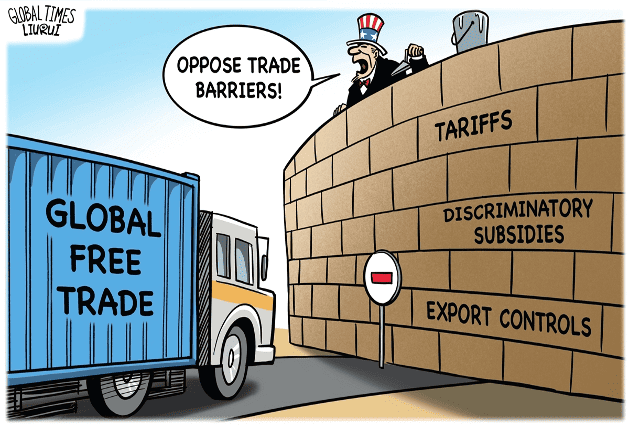
US politicians are advocating for steep tariffs, echoing the protectionist Fordney-McCumber Tariff of 1922. Despite potential international retaliation, risks to global economic rules and a shift from post-World War II principles, US politicians have promised to increase trade barriers against China, causing concerns for the sustainability of global economic harmony. A century ago, the Republican Congress passed the Fordney-McCumber Tariff of 1922. This post-World War-I effort to protect the US from German competition and rescue America's own businesses from falling prices sparked a global wave of tariff hikes. While long forgotten, echoes of Fordney-McCumber now reverberate across the US political landscape. Once again, politicians are grasping the tariff as a magic talisman against its own economic ills and to contain the rise of China. The Democratic Party of the 1920s opposed tariffs, because duties are harmful to consumers and farmers, but today both President Joe Biden and former President Donald Trump favor national delivery through protectionism. Trump promised that his second term, if elected, would impose 60-percent tariffs on everything arriving from China and 10-percent tariffs on imports from the rest of the world, apparently including the imports covered by 14 free trade agreements with America's 20 partners. He initially promised 100-percent tariffs on electric vehicles (EVs), but when Biden declared that he was hiking tariffs on EVs from China to 100-percent, Trump raised the ante to 200-percent. On May 14, 2024, the White House imposed tariffs ranging from 25 percent (on items such as steel, aluminum and lithium batteries) to 50 percent (semiconductors, solar cells, syringes and needles) and 100 percent (electric vehicles) on Chinese imports. US government officials offer "national security" and "supply chain vulnerability" as the justification for levying high tariffs. To deflect worries about inflation, US Trade Representative Katherine Tai declared, "first of all, I think that that link, in terms of tariffs to prices, has been largely debunked." Contrary findings by the United States International Trade Commission and a number of distinguished economists, as well as Biden's own 2019 statement criticizing Trump's tariffs - "Trump doesn't get the basics. He thinks tariffs are being paid by China… [but] the American people are paying his tariffs" - forced Tai's office to wind back her declaration. The fact that prohibitive barriers to imports of solar cells, batteries and EVs will delay the green economy carries zero political weight with Trump and little with Biden. Nor does either of them worry about the prospects of Chinese retaliation and damage to the fabric of global economic rules. Historical lessons - unanticipated consequences of the foolish Fordney-McCumber Tariff of 1922 and the Smoot-Hawley Tariff of 1930 - are seen as irrelevant by the candidates and their advisers. The US' lurch from its post-World War II free trade principles offers China a golden opportunity. On the world stage, China will espouse open free trade and investment. China will encourage EV and battery firms to establish plants in Europe, Brazil, Mexico and elsewhere, essentially daring the US to damage its own alliances by restricting third country imports containing Chinese components. Whether the fabric of global economic rules that has delivered astounding prosperity to the world will survive through the 21st century remains to be seen. Much will depend on the decisions of other large economic powers, not only China but also the European Union and Japan, as well as middle powers, such as Australia, Brazil, Chile, ASEAN and South Korea. Their actions and reactions will reshape the rules of the 21st century. If others follow America down this costly path, the world will become less prosperous and vastly more unpredictable. If they resist, the US risks being diminished and more isolated. The author is a non-resident Senior Fellow at the Peterson Institute of International Economics. bizopinion@globaltimes.com.cn