"Pictures on the wall were falling," New Yorkers rattled by earthquake
An earthquake jolted New York City on Friday morning, followed by more than 10 aftershocks which shook New Jersey, sending tremors as far as Philadelphia to Boston and jolting buildings in Manhattan and throughout its five boroughs. The preliminary quake, measuring 4.8 magnitude, centered around Lebanon, New Jersey, approximately 60 kilometers from New York City, with a depth of about 5 kilometers. Following the earthquake, New York City mayor Eric Adams stated at a press conference that no injuries had been reported, but they would continue to monitor and inspect critical infrastructure. The densely populated New York City was caught off guard by the unusual event. Broadcaster CBS reported that New York had not experienced an earthquake of this magnitude since 1884. Residents in Brooklyn expressed their shock when experiencing tremors which shook the city. "At first, I thought it was just construction next door, but then I noticed the pictures on the wall had fallen," Jennifer Wu, a resident in New York, told the Global Times on Saturday. Video footage circulating online showed the Statue of Liberty and the New York City skyline trembling as the earthquake struck. An angle from directly above Lady Liberty caught Ellis Island shaking during the incident. "It is fine," New York's famous Empire State Building posted on social platform X after the earthquake. The United Nations headquarters located in New York was hosting a Security Council meeting on the Israeli-Palestinian issue, and diplomats present in the meeting felt the tremors, local media reported. According to the Weather Channel, residents in Baltimore, Philadelphia, New Jersey, Connecticut, Boston and other areas of the Northeast seaboard also reported shaking. Tremors lasting for several seconds were felt over 200 miles away near the Massachusetts-New Hampshire border. The New York mayor told the press that New Yorkers should go about their normal day, while the governor Kathy Hochul emphasized the seriousness of the situation. She initiated assessments for damage across the state and had discussions with New Jersey Governor Phil Murphy. The quake caused flight delays throughout the New York area, with temporary control measures put in place across New York's John F. Kennedy International Airport, Newark Liberty International Airport in Newark, New Jersey, and Baltimore-Washington's Thurgood Marshall International Airport, checking for damage to runways. Operations resumed around Friday noon, ABC reported.

Google may bring Google Wallet for Indian users
Google Wallet can help you store your IDs, driving license, loyalty cards, concert tickets and more. You can also store your payment cards and use tap to pay to pay anywhere Google Pay is accepted. Google wallet is available in various countries but Google never launched it in India. Google let indian users stick with the Gpay which facilitates UPI payments. Tap to pay is not part of it. Also we can not store things such as IDs and Passes in indian version of Gpay. This might change and Google may launch Google Wallet in India. With the recent version of Google Wallet and Google Play Services, Google has added some flags and code which indicate that Google is working on something for Indian users regarding wallet. The first change I noticed recently when going through the Google Play Services apk was addition of two new flags Both flags are part of com.google.android.gms.pay package in the Google Play Services. This package contains all the flags for features of Gpay/Wallet. Google does server side flipping of flags to enable/disable features for users. So both these flags doesn't really provide any info about what features enabling these flags is going to bring. But the point here is that Google Wallet is not launched in India so why Google added these flags inside Play Services ? The answer could be that Google may be working on bringing Google Wallet to India. It can enable tap to pay, store payments and various other features for Indian users which we don't have in the current Gpay for India. I found similar flags in the analysis Google Wallet APK - These flags are also disabled by default. But this is again a clear indication of Google working towards something for Indian users. In both cases, enabling the flags doesn't bring anything noticeable UI or feature because there is nothing much added besides flags. Google has dogfood/testing versions internally, so the code will show up slowly in upcoming versions. The last piece of code I found is also from Google Play Services. In case you don't know, Google was working on Digilocker integration in the Google Files app which was supposed to bring your digital document inside the app such as driving license, COVID certificates, aadhar card. But Google has ditched the effort of bringing these features and they removed the "Important" tab (where digilocker was supposed to be integrated) from the Google Files app completely. So things are going to change and here is how. This is the code which I found in the Google Play Services - So the word "PASS" along with PAN, DRIVERS LICENCE, VACC CERTIFICATE & AADHAR CARD, is clear indication of the possibility of Google adding support for these directly through Google Wallet using Digilocker, just like Samsung Pass does it. This code is not old as I have checked older beta versions of Play Services where this code is not present. Here is a string which was added in a previous beta version a few weeks ago but I completely ignored it because it didn't make any sense without flags and the other code - This addition was surprising because there was nothing regarding digilocker before in the Play Services. In the words "pay_valuable", the "pay" to Wallet/Gpay and "valuable" refers to the things like Passes, loyalty cards and transit cards. Since we are talking about digilocker, these "valuable" are driving license, vaccination certificate, PAN card and Aadhar card which can be store in Google Wallet after digilocker integration. That's all about it. We will know more about it in upcoming app updates or maybe Google can itself annouce something about this.
Beyond the aurorae: How solar flares spill out across the Solar System
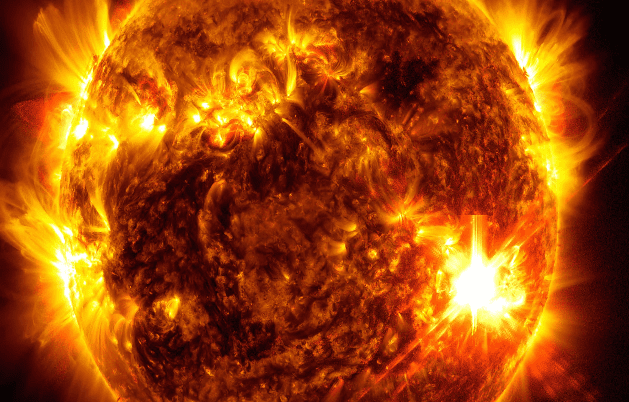
The Sun is extremely active right now, blasting the Earth with the biggest solar storms in 20 years. This is what it is doing to the rest of the Solar System. If you happened to look skywards on a few nights in May 2024, there was a good chance of seeing something spectacular. For those at relatively low latitudes, there was a rare chance to see the flickering red, pink, green glow of our planet's aurorae. A powerful solar storm had sent bursts of charged particles barrelling towards Earth and, as they bounced around in our planet's atmosphere, they unleashed spectacular displays of the Northern and Southern Lights. The dazzling displays of aurora borealis were visible far further south than they might normally be – and far further north in the case of aurora australis thanks to the power of the geomagnetic storm, the strongest in two decades. Although some people experienced only a faint, eerie glow, others were treated to a myriad of colour as far south as London in the UK and Ohio in the US. Reports even came in from just to the north of San Francisco, California. But while this spike in activity from the Sun left many on Earth transfixed by the light display it produced, it has also had a profound effect elsewhere in the Solar System. As most of us wondered at the colours dancing across the night's sky, astronomers have been peering far beyond to see the strange ways such intense bursts of particles affect other planets and the space between them. "The Sun can fire material outwards in any direction like a garden sprinkler," says Jim Wild, a professor of space physics at Lancaster University in the UK. "The effects are felt throughout the Solar System." Our Sun is currently heading towards, or has already reached, its solar maximum – the point in an 11-year cycle where it is most active. This means the Sun produces more bursts of radiation and particles from solar flares and events known as coronal mass ejections (CMEs). If these are sprayed in our direction, they can supercharge the Earth's magnetic field, causing magnificent aurorae but also posing problems for satellites and power grids. "Things really seem to be picking up right now," says Mathew Owens, a space physicist at the University of Reading in the UK. "I think we're about at solar maximum now, so we may see more of these kinds of storms in the next couple of years." Around the Sun, multiple spacecraft are observing this increase in activity up close. One of those, the European Space Agency's (Esa) Solar Orbiter, has been studying the Sun since 2020 on an orbit that takes it within the path of Mercury. Currently the spacecraft is "on the far side of the Sun as seen from Earth", says Daniel Müller, project scientist for the Solar Orbiter mission at Esa in the Netherlands. "So we see everything that Earth doesn't see." The storm that hit Earth in May originated from an active region of solar flares and sunspots, bursts of plasma and twisting magnetic fields on the Sun's surface, known as its photosphere. Solar Orbiter was able to see "several of the flares from this monster active region that rotated out of Earth's view", says Müller, bright flashes of light and darkened regions called sunspots on the Sun's surface. One of the goals of Solar Orbiter is "to connect what's happening on the Sun to what's happening in the heliosphere," says Müller. The heliosphere is a vast bubble of plasma that envelops the Sun and the planets of the Solar System as it travels through interstellar space. What Müller and his colleagues hope to learn more about is where the solar wind – the constant stream of particles spilling out from the Sun across the Solar System – "blows into the interstellar medium", he says. "So we are particularly interested in anything energetic on the Sun that we can find back in the turbulence of the solar wind." This particular cycle, cycle 25, appears to be "significantly more active than what people predicted", says Müller, with the relative sunspot number – an index used to measure the activity across the visible surface of the Sun – eclipsing what was seen as the peak of the previous solar cycle. The National Oceanic and Atmospheric Administration (Noaa) in the US had predicted a maximum monthly average of 124 sunspots a day in May, but the actual number was 170 on average, with one day exceeding 240, according to Müller. But the exact cause of the Sun's 11-year-long cycle and its variabilities remains a bit of a mystery. • Alien aurora: The strange displays that light up other worlds • Why Einstein was wrong about black holes • The Moon is slipping away from the Earth – and our days are getting longer The effects of these changes in solar activity, however, extend far across the Solar System. Earth is not the only planet to be hit by solar storms as they billow across interplanetary space. Mercury, the closest planet to the Sun, has a much weaker magnetic field than Earth – about 100 times less – and lacks a substantial atmosphere. But solar activity can cause the surface of the planet to glow with X-rays as solar wind rains down. Venus also lacks a substantial magnetic field, but the planet does still create auroras as the solar wind interacts with the planet's ionosphere. At Mars, the effect of solar activity is more obvious. Here, a Nasa spacecraft called Maven (Mars Atmosphere and Volatile Evolution) has been studying the planet's atmosphere from orbit since 2014. "We were on the declining side of solar cycle 24 [then]," says Shannon Curry, a planetary scientist at the University of Colorado, Boulder in the US and the lead on the mission. "We are now coming up on the peak of cycle 25, and this latest series of active regions has produced the strongest activity Maven has ever seen." Between 14 and 20 May the spacecraft detected exceptionally powerful solar activity reaching Mars, including an X8.7 – solar flares are ranked B, C, M, and X in order from weakest to strongest. Results from the event have yet to be studied, but Curry noted that a previous X8.2 flare had resulted in "a dozen papers" published in scientific journals. Another flare on 20 May, later estimated to be an even bigger X12, hurled X-rays and gamma rays towards Mars before a subsequent coronal mass ejection launched a barrage of charged particles in the same direction. Images beamed back from Nasa's Curiosity Rover on Mars revealed just now much energy struck the Martian surface. Streaks and dots caused by charged particles hitting the camera's sensors caused the images to "dance with snow", according to a press release from Nasa. Maven, meanwhile, captured glowing aurora as the particles hit the Mars' atmosphere, engulfing the entire planet in an ultraviolet glow. The flares can cause the temperature of the Martian atmosphere to "dramatically increase," says Curry. "It can even double in the upper atmosphere. The atmosphere itself inflates. The entire atmosphere expands dozens of kilometres – exciting for scientists but detrimental for spacecraft, because when the atmosphere expands there's more drag on the spacecraft." The expanding atmosphere can also cause degradation of the solar panels on spacecraft orbiting Mars from the increase in radiation. "The last two flares caused more degradation than what a third of a year would typically do," says Curry. Mars, while it has lost most of its magnetic field, still has "crustal remnant magnetic fields, little bubbles all over the southern hemisphere", says Curry. During a solar event, charged particles can light those up and excite particles. "The entire day side lights up in what we call a diffuse aurora," says Curry. "The entire sky glows. This would most likely be visible to astronauts on the surface." By the time solar storms reach further out into the solar system, they tend to have dissipated but can still have an impact on the planets they encounter. Jupiter, Saturn, Uranus, and Neptune all have aurorae that are in part driven by charged particles from the Sun interacting with their magnetic fields. But one of the key effects of solar activity on interplanetary space that astronomers are eager to study is something called "slow solar wind", a more sluggish, but denser stream of charged particles and plasma from the Sun. Steph Yardley, a solar astronomer at Northumbria University in the UK, says solar wind is "generally classed about 500km/s (310 miles/s)", but slow wind falls below this. It also has a lower temperature and tends to be more volatile. Recent work by Yardley and her colleagues, using data from Solar Orbiter, suggests that the Sun's atmosphere, its corona, plays a role in the speed of the solar wind. Regions where the magnetic field lines, the direction of the field and charged particles are "open" – stretching out into space without looping back – provide a highway for solar wind to reach high speeds. Closed loops over some active regions – where the magnetic field lines have no beginning and end – can occasionally snap, producing slow solar wind. The variability in the slow solar wind seems to be driven by the unpredictable flow of plasma inside the Sun, which makes the magnetic field particularly chaotic. The X-class flares and coronal mass ejections seen in May transformed the interplanetary medium as they flung out material across the solar system. Solar Orbiter detected a huge spike in ions moving at thousands of kilometres per second immediately after the 20 May flare. Computers on board other spacecraft – the BepiColombo probe, which is currently on a seven-year journey to Mercury, and Mars Express, in orbit around the Red Planet – both saw a dramatic increase in the number of memory errors caused by the high energy solar particles hitting the memory cells. The day after the coronal mass ejection, magnetometers on board the Solar Orbiter also saw large swings in the magnetic field around the spacecraft as a huge bubble of plasma made up of charged particles thrown out from by the event washed past it at 1,400km/s (870 miles/s). Increased solar activity is a boon for scientists. "If you track the number of papers produced by solar physicists, you can almost see an 11-year cycle in there," says Owens. "We are all more scientifically productive when there's a lot of activity to study." As the Sun continues into solar maximum, the Solar System will see more and more activity streaming from its surface. Yet while all the planets witness at least some of the activity, our planet bears the brunt more than most. "Earth is slightly unique in that space weather can have interesting effects on human technologies," says Wild. "There's an extra dimension here on Earth." Perhaps one day those anthropogenic effects might be felt elsewhere, too. "If you're going to fly to Mars and you have a six-month flight through the interplanetary environment, you're going to potentially suck up a lot of space weather events," says Wild. "How you protect your astronauts is an interplanetary issue that we need to get our heads around."

Coexisting and cooperating with China is the only choice for the US
US Secretary of State Antony Blinken declared at the Munich Security Conference: "If you're not at the table in the international system, you're going to be on the menu." The arrogant thinking of American political elites is evident: Whoever does not comply with the US will be excluded from the table of the American-led system and put on the menu. How arrogant. The US is actively pushing for "decoupling" from China and trying to persuade the entire West to "decouple" from China, using the term "de-risking." Washington hopes to ultimately contain China's development in order to maintain American hegemony. However, this time, Washington is facing a historically experienced and strategically rich Eastern civilization. Previous opponents targeted by the US have chosen to confront the US strategically. The US not only has the strongest technological and military capabilities but also controls global financial and information networks with a large number of allies. Those countries that had engaged in direct confrontations had suffered losses. Some of them had disintegrated, some had been weakened, and some had fallen into difficulties. However, what Washington sees from China is strategic composure and resilience. China is now staging an unprecedented and grand "Tai Chi." However, some Chinese people feel that this is not enough: Why can't we confront the US head-on? But I want to say that this is precisely the brilliance of China. This grand "Tai Chi" is about dismantling the pressure the US is putting on China. Europe is different from the US. A European diplomat once said in private that the topic of China has become toxic in the US, but in Europe, it is still possible to openly display friendliness toward China. There is genuine competition between the Europe and China despite Europe leans more toward the US between China and the US. Only in terms of ideology does the term "West" truly exist. In terms of fundamental economic interests, Europe has considerable independence. In terms of security, their attitude toward China also differs greatly from that of the US. In the Asia-Pacific region or China's periphery, the US wants to create an "Asian NATO." The specific situations of countries in dispute with China are very different. China has enormous influence in the region, is the largest trading partner of the vast majority of countries in the region and has friendly relations with most countries in the region. The disputes with countries are not fundamental strategic conflicts, and China has the ability to manage disputes with each specific country and push them to move toward neutrality to varying degrees without being tied to the US' policy toward China. China has a lot of trading partners and stakeholders in the US. The trade volume between China and the US, despite the decline, reached $664.4 billion in 2023, which shows China's huge presence in the US, and is the bond of the two countries in the current situation. The US is not a country where the political elites can have absolute say, and the huge interests have forced the US president and senior officials to repeatedly proclaim that they "don't want to decouple from China" and instead they want to "manage the US-China competition" and see "preventing a war with China" as clearly in everyone's best interest. China should engage in a "strategic battle" with the US at the closest possible distance. We need to maintain friendly relations with certain forces within the US, speed up the resumption of flights between the two countries, increase personnel exchanges and completely reverse the downturn of China-US contacts during the pandemic. In addition to the above dismantling, we also have the huge increment in the "Belt and Road." This initiative will increase China's power to compete with the US, greatly extending the front line that the US needs to maintain in containing China, making the US more powerless. In order to dismantle the US strategy toward China, China must become more diversified while maintaining strategic consistency. Our national diplomacy toward the US is very principled, rational and determined, which is clearly different from other countries targeted by the US. Our public diplomacy toward the US needs to be unique, with both "anti-American voices" and efforts to maintain friendly relations between the two societies and further expand economic and practical cooperation with the US. Just as eagles have their own way of flying and doves have their own formation, just as we see the US as complex, China must also be seen as complex in the eyes of the US. China is both a geopolitical concern and a profitable investment destination for them, and is one of the largest trading partners that is difficult to replace. Some American political elites proclaim China as an "enemy," but it is important to make the majority of Americans feel that China is not. No matter how intense the struggles between China and the US may be, we cannot shape the entire US toward an enemy direction. China has to make the US political elites recognize that it is futile to deal with China in the same way as it historically dealt with the Soviet Union and other major powers. Furthermore, willingly or unwillingly, coexistence and cooperation with China will be their only choice.