US' ban on high-tech investment cannot stifle China's high-tech development
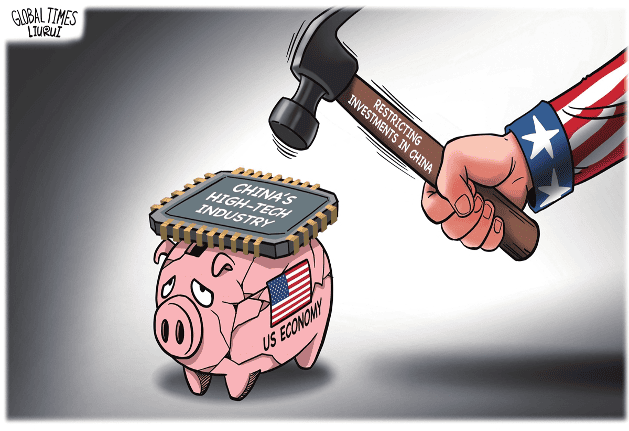
US President Joe Biden signed an executive order on Wednesday restricting investments in China, intended to further stymie China's advances in three cutting-edge technology areas: semiconductors and microelectronics, quantum information technologies and certain artificial intelligence systems. The "decoupling" of high tech from China began under Donald Trump, and the Biden administration has continued that ambition. However, the new order doesn't target US investments already invested in China, but the new ones. The Biden administration has repeatedly claimed that the US restrictions will be narrowly targeted and will not "have a fundamental impact on affecting the investment climate for China." Biden's new executive order is still subject to consultation with the US business community and the public and is not expected to take effect until next year. The order has been brewed for a long time and has generated a lot of publicity. But almost no one believes that this executive order will deal a new practical blow to Chinese high technology, because almost everyone knows that China needs American technology more than American money. The order has gained much attention because it is seen as part of a broader trend of the US drifting away from China. The promulgation and brewing process of the executive order reflects the strong desire of American political elites to suppress China's high-tech development, as well as a fierce game between those supporting the executive order and the concerns of the technology and economic sectors about a potential backfire on the US. It is a kind of compromise. Washington obviously hopes that major allies will follow Biden's executive order. The UK's Sunak government has made cautious statements, stating that it is consulting business and the financial sector before deciding whether to follow suit. In fact, China also has the ability to influence the extent to which Biden's executive order is implemented, as well as the extent to which the US will go in terms of "decoupling" from China. We are definitely not just passive recipients of US policies. American political elites are eager to "decouple" from China as quickly and deeply as possible, but they fear two things: First, this will immediately damage the performance of relevant high-tech companies in the US, undermine their influence and further innovation. The current Biden administration, in particular, does not want to incur strong resentment from Silicon Valley and Wall Street toward the escalating "decoupling," which will ultimately lead to the loss of support for the Democratic Party. Second, they are afraid of pushing China toward more resolute independent innovation to achieve breakthroughs in key technologies such as chips. If the US "decoupling" policy gives birth to major technological achievements in China, it means that Washington will completely lose the gamble: They originally wants to stifle China's high-tech development, but ends up strangling their own companies. What China needs to do next is to fully unleash our innovation vitality, continuously reduce our dependence on high-tech products from the US, and prove that as long as we are determined to achieve independent innovation, we have the ability to accomplish things. We need to prove that being pressured by the US will only make us stronger. As long as there are several solid proofs of this trend, the US policy community will fall into unprecedented chaos, and their panic will be much more severe than when they saw the rapid expansion of the Chinese economy before Trump started the trade war. Regardless of the future of China-US relations, the current battle will be the key battle that determines the future competition between China and the US. China can only win and cannot afford to lose. High-tech products such as chips are not isolated. The innovation power of China's entire manufacturing industry and the creative vitality of the whole society are the foundation for shaping these key achievements. When pressured by the US, our society needs to generate confidence and resilience from all directions, and we need to accelerate and seize every opportunity, rather than shrink and simply defend. Otherwise, the US will gain the upper hand in momentum, and we will truly be in a passive and defensive position. We must see that the US is on the offensive, but its offensive is becoming weaker and weaker, and it is always hesitant with each step. What is presented to China are difficulties and risks, but also the dawn of victory.
Explainer: How Boeing's Starliner can bring its astronauts back to Earth
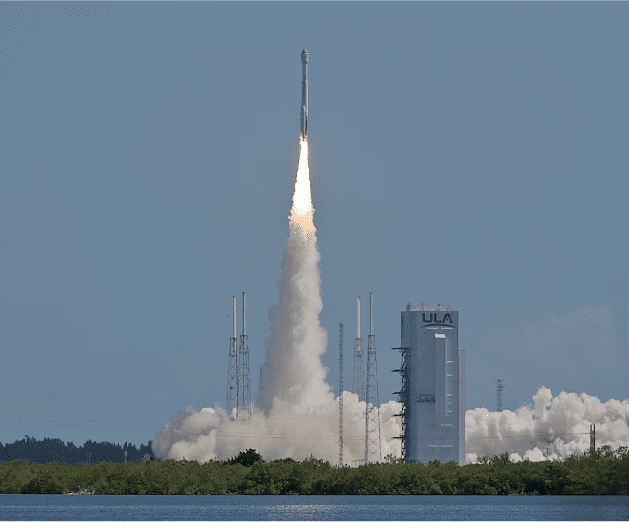
WASHINGTON, June 24 (Reuters) - Problems with Boeing's Starliner capsule, still docked at the International Space Station (ISS), have upended the original plans for its return of its two astronauts to Earth, as last-minute fixes and tests draw out a mission crucial to the future of Boeing's (BA.N), opens new tab space division. NASA has rescheduled the planned return three times, and now has no date set for it. Since its June 5 liftoff, the capsule has had five helium leaks, five maneuvering thrusters go dead and a propellant valve fail to close completely, prompting the crew in space and mission managers in Houston to spend more time than expected pursuing fixes mid-mission. Here is an explanation of potential paths forward for Starliner and its veteran NASA astronauts, Barry "Butch" Wilmore and Sunita "Suni" Williams. THE CURRENT SITUATION Starliner can stay docked at the ISS for up to 45 days, according to comments by NASA's commercial crew manager Steve Stich to reporters. But if absolutely necessary, such as if more problems arise that mission officials cannot fix in time, it could stay docked for up to 72 days, relying on various backup systems, according to a person familiar with flight planning. Internally at NASA, Starliner's latest targeted return date is July 6, according to this source, who spoke on condition of anonymity. Such a return date would mean that the mission, originally planned for eight days, instead would last a month. Starliner's expendable propulsion system is part of the craft's "service module." The current problems center on this system, which is needed to back the capsule away from the ISS and position it to dive through Earth's atmosphere. Many of Starliner's thrusters have overheated when fired, and the leaks of helium - used to pressurize the thrusters - appear to be connected to how frequently they are used, according to Stich.
Google extends Linux kernel support to 4 years
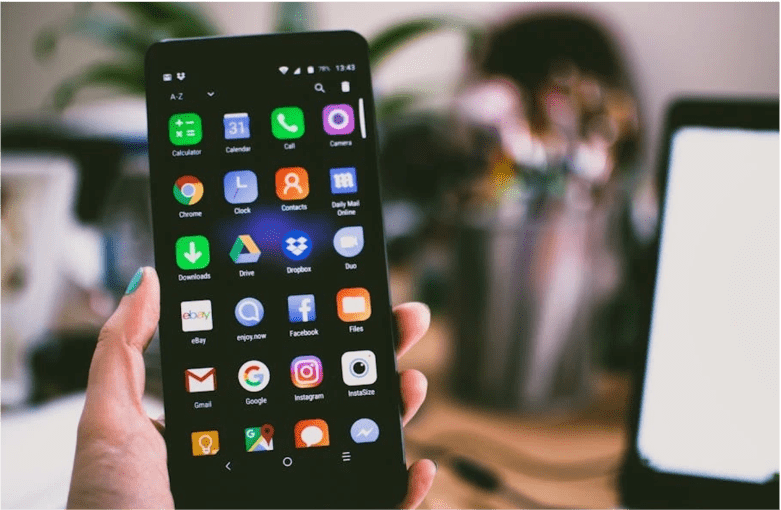
According to AndroidAuthority, the Linux kernel used by Android devices is mostly derived from Google's Android Universal Kernel (ACK) branch, which is created from the Android mainline kernel branch when new LTS versions are released upstream. For example, when kernel version 6.6 is announced as the latest LTS release, an ACK branch for Android15-6.6 appears shortly after, with the "android15" in the name referring to the Android version of the kernel (in this case, Android 15). Google maintains its own set of LTS kernel branches for three main reasons. First, Google can integrate upstream features that have not yet been released into the ACK branch by backporting or picking, so as to meet the specific needs of Android. Second, Google can include some features that are being developed upstream in the ACK branch ahead of time, making it available for Android devices as early as possible. Finally, Google can add some vendor or original equipment manufacturer (OEM) features for other Android partners to use. Once created, Google continues to update the ACK branch to include not only bug fixes for Android specific code, but also to integrate the LTS merge content of the upstream kernel branch. For example, the Linux kernel vulnerability disclosed in the July 2024 Android security bulletin will be fixed through these updates. However, it is not easy to distinguish a bug fix from other bug fixes, as a patch that fixes a bug may also accidentally plug a security vulnerability that the submitter did not know about or chose not to disclose. Google does its best to recognize this, but it inevitably misses the mark, resulting in bug fixes for the upstream Linux kernel being released months before Android devices. As a result, Google has been urging Android vendors to regularly update the LTS kernel to avoid being caught off guard by unexpectedly disclosed security vulnerabilities. Clearly, the LTS version of the Linux kernel is critical to the security of Android devices, helping Google and vendors deal with known and unknown security vulnerabilities. The longer the support period, the more timely security updates Google and vendors can provide to devices.
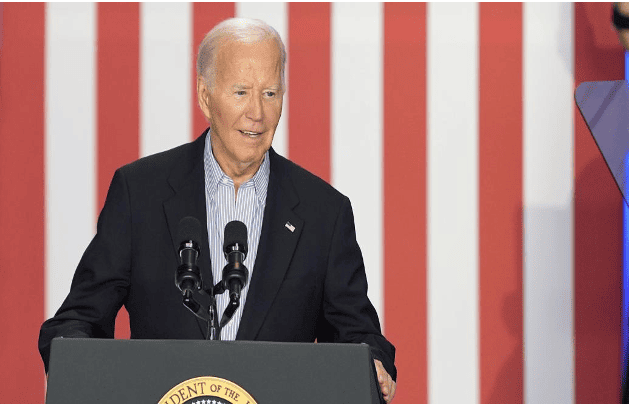
Doctors visited the White House 8 times? White House: Biden did not receive treatment for Parkinson's disease
White House spokeswoman Karina Jean-Pierre denied a report in the U.S. media on the 8th that President Joseph Biden did not receive treatment for Parkinson's disease. Biden had the first televised debate of the 2024 presidential election with Republican opponent Donald Trump on June 27, and his poor performance on the spot triggered discussions about his physical condition. The New York Times reported that a doctor specializing in the treatment of Parkinson's disease had "visited" the White House eight times from August last year to March this year. Facing the media's questions about Biden's health, Jean-Pierre asked and answered himself at a regular White House press conference on the 8th: "Has the president received treatment for Parkinson's disease? No. Is he currently receiving treatment for Parkinson's disease? No, he is not. Is he taking medication for Parkinson's disease? No." Jean-Pierre said Biden had seen a neurologist three times, all related to his annual physical examination. She also took out the report issued by the doctor after Biden's most recent physical examination in February this year. The report said, "An extremely detailed neurological examination was once again reassuring" because no symptoms consistent with stroke, multiple sclerosis or Parkinson's disease were found. The doctor who went to the White House mentioned by the New York Times is Kevin Kanal, a neurology and movement disorder expert at the Walter Reed National Military Medical Center in Maryland and an authority on Parkinson's disease. Jean-Pierre suggested that the doctor might have come to treat military personnel on duty at the White House.
NASA plays 'blame-shifting' game with China as lunar soil research set to start
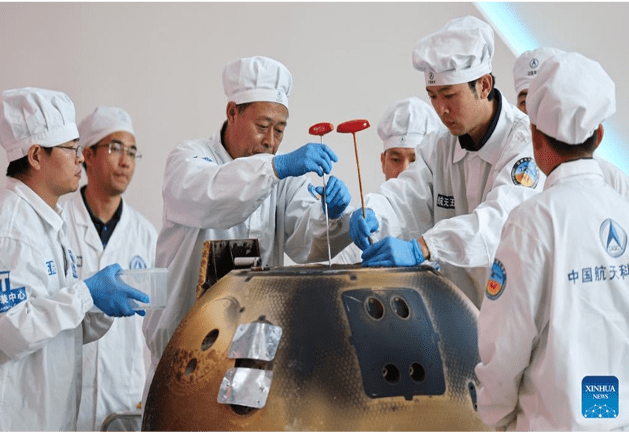
The returner of the Chang'e-6 lunar probe is opened during a ceremony at the China Academy of Space Technology under the China Aerospace Science and Technology Corporation in Beijing, capital of China, June 26, 2024. The returner of the Chang'e-6 lunar probe was opened at a ceremony in Beijing on Wednesday afternoon. During the ceremony at the China Academy of Space Technology under the China Aerospace Science and Technology Corporation, researchers opened the returner and examined key technical indicators. Photo: Xinhua As the US space industry recently faced yet more delays and stagnation with key components including manned spacecraft and space suits "going wrong," NASA has once again resorted to its "sour grapes" rhetoric upon seeing China's successful retrieval of fresh lunar soils from the far side of the moon, by claiming that China did not directly invite its scientists to participate in the lunar soil research. This behavior is a typical blame-shifting trick, Chinese experts said, noting it is clear to all that it is the US' own laws, not China, that are restricting space cooperation between the two sides. Instead of deceiving themselves by distorting the truth, the US should face up to its own problem of overall weakening engineering capability and the lack of long-term planning in its space industry. After the Chang'e-6 samples, weighing nearly 2 kilograms, were safely transported to a special laboratory for further study on Friday, NASA spokesperson Faith McKie told media that while China worked with the European Space Agency, France, Italy and Pakistan on this mission, "NASA wasn't invited to take part in the moon probe." NASA also didn't get "any direct invitation" to study China's moon rocks, after it welcomed all scientists from around the world to apply to study them, McKie told NatSec Daily. Responding to the remarks, Chinese Foreign Ministry spokesperson Mao Ning told the Global Times on Monday that China is open to having space exchanges with the US, and we also welcome countries around the world to take part in the study of lunar samples. "However, the US side seems to have forgotten to mention its domestic legislation such as the Wolf Amendment. The real question is whether US scientists and institutions are allowed by their own government to participate in cooperation with China," Mao said. "The existence of the Wolf Amendment has basically shut the door to space collaboration between the two countries," Wang Yanan, chief editor of Beijing-based Aerospace Knowledge magazine, told the Global Times on Monday. Even if research institutions of the US have the willingness to work with China on opportunities such as lunar sample research, institutions there must obtain special approval from the US Congress due to the presence of this amendment, Wang explained. Currently, no such "green light" is in sight from the Congress. Furthermore, China's collaboration with international partners is based on equality and mutual benefit, leveraging their respective scientific resources, facilities, and expertise. However, the US only wants what it doesn't have, and its engagement with China would be advantageous only to itself, Wang noted. NASA has found itself embroiled in a number of thorny issues recently, with the latest being Boeing's Starliner manned spaceship experiencing both helium leaks and thruster issues during a June 6 docking with the International Space Station (ISS), which led to an indefinite delay for its crew's return to Earth, despite NASA's insistence that they are not "stranded" in space. The return of the Starliner capsule, while has already been delayed by two weeks, will be put on hold "well into the summer" pending results of new thruster tests, which are scheduled to start Tuesday and will take approximately two weeks or even more, per NASA officials. Previously on June 24, NASA cancelled a spacewalk on the ISS following a "serious situation," when one of the spacesuits experienced coolant leak in the hatch. While being broadcast on a livestream, the astronauts reported "literally water everywhere" as they were preparing for the extravehicular activity, space.com reported. The report said that this is the second time this particular spacewalk was postponed, after a June 13 attempt with a different astronaut group was pushed back due to a "spacesuit discomfort." The recurring issues with the spacesuits are due to their much-extended service lifespan, media reported, as the puffy white ones US astronauts currently wear were designed more than 40 years ago. Despite the pressing need to replace them, NASA announced recently that it is abandoning a plan to develop next-generation spacesuits, which had been committed to be delivered by 2026, CNN reported on Thursday. One of the root causes for such problems is that the US has developed many large technology conglomerates, which for a long time have benefited significantly from government orders and industry monopolies. Consequently, in many complex engineering fields, the level of attention given is greatly insufficient, Wang noted. It also reflected the US' lack of long-term strategic planning for its manned space program. For instance, the ageing spacesuits should have been replaced a decade ago to ensure that operational suits remain in usable condition. Failure to address this issue results in a hindrance to the space station's necessary maintenance tasks and even poses life-threatening risks to astronauts in emergency situations, experts said. The issues with Boeing's spacecraft and the spacesuits are not isolated problems, but reflected a systemic issue in the US space industry - the overall weakening of engineering capabilities, they noted.