link1s.site

US politicians' lurch to levying high tariffs to damage global economic sustainability

US politicians are advocating for steep tariffs, echoing the protectionist Fordney-McCumber Tariff of 1922. Despite potential international retaliation, risks to global economic rules and a shift from post-World War II principles, US politicians have promised to increase trade barriers against China, causing concerns for the sustainability of global economic harmony.

A century ago, the Republican Congress passed the Fordney-McCumber Tariff of 1922. This post-World War-I effort to protect the US from German competition and rescue America's own businesses from falling prices sparked a global wave of tariff hikes.

While long forgotten, echoes of Fordney-McCumber now reverberate across the US political landscape. Once again, politicians are grasping the tariff as a magic talisman against its own economic ills and to contain the rise of China.

The Democratic Party of the 1920s opposed tariffs, because duties are harmful to consumers and farmers, but today both President Joe Biden and former President Donald Trump favor national delivery through protectionism.

Trump promised that his second term, if elected, would impose 60-percent tariffs on everything arriving from China and 10-percent tariffs on imports from the rest of the world, apparently including the imports covered by 14 free trade agreements with America's 20 partners. He initially promised 100-percent tariffs on electric vehicles (EVs), but when Biden declared that he was hiking tariffs on EVs from China to 100-percent, Trump raised the ante to 200-percent.

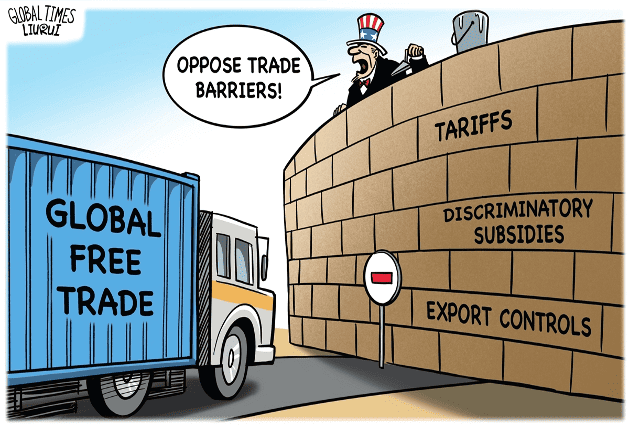
On May 14, 2024, the White House imposed tariffs ranging from 25 percent (on items such as steel, aluminum and lithium batteries) to 50 percent (semiconductors, solar cells, syringes and needles) and 100 percent (electric vehicles) on Chinese imports. US government officials offer "national security" and "supply chain vulnerability" as the justification for levying high tariffs.

To deflect worries about inflation, US Trade Representative Katherine Tai declared, "first of all, I think that that link, in terms of tariffs to prices, has been largely debunked."

Contrary findings by the United States International Trade Commission and a number of distinguished economists, as well as Biden's own 2019 statement criticizing Trump's tariffs - "Trump doesn't get the basics. He thinks tariffs are being paid by China… [but] the American people are paying his tariffs" - forced Tai's office to wind back her declaration.

The fact that prohibitive barriers to imports of solar cells, batteries and EVs will delay the green economy carries zero political weight with Trump and little with Biden. Nor does either of them worry about the prospects of Chinese retaliation and damage to the fabric of global economic rules. Historical lessons - unanticipated consequences of the foolish Fordney-McCumber Tariff of 1922 and the Smoot-Hawley Tariff of 1930 - are seen as irrelevant by the candidates and their advisers.

The US' lurch from its post-World War II free trade principles offers China a golden opportunity. On the world stage, China will espouse open free trade and investment. China will encourage EV and battery firms to establish plants in Europe, Brazil, Mexico and elsewhere, essentially daring the US to damage its own alliances by restricting third country imports containing Chinese components.

Whether the fabric of global economic rules that has delivered astounding prosperity to the world will survive through the 21st century remains to be seen. Much will depend on the decisions of other large economic powers, not only China but also the European Union and Japan, as well as middle powers, such as Australia, Brazil, Chile, ASEAN and South Korea. Their actions and reactions will reshape the rules of the 21st century.

If others follow America down this costly path, the world will become less prosperous and vastly more unpredictable. If they resist, the US risks being diminished and more isolated.

The author is a non-resident Senior Fellow at the Peterson Institute of International Economics. bizopinion@globaltimes.com.cn


Israeli strike kills 16 at Gaza school, military says it targeted gunmen
CAIRO/GAZA, July 6 (Reuters) - At least 16 people were killed in an Israeli strike on a school sheltering displaced Palestinian families in central Gaza on Saturday, the Palestinian health ministry said, in an attack Israel said had targeted militants. The health ministry said the attack on the school in Al-Nuseirat killed at least 16 people and wounded more than 50. The Israeli military said it took precautions to minimize risk to civilians before it targeted the gunmen who were using the area as a hideout to plan and carry out attacks against soldiers. Hamas denied its fighters were there. At the scene, Ayman al-Atouneh said he saw children among the dead. "We came here running to see the targeted area, we saw bodies of children, in pieces, this is a playground, there was a trampoline here, there were swing-sets, and vendors," he said. Mahmoud Basal, spokesman of the Gaza Civil Emergency Service, said in a statement that the number of dead could rise because many of the wounded were in critical condition. The attack meant no place in the enclave was safe for families who leave their houses to seek shelters, he said. Al-Nuseirat, one of Gaza Strip's eight historic refugee camps, was the site of stepped-up Israeli bombardment on Saturday. An air strike earlier on a house in the camp killed at least 10 people and wounded many others, according to medics. In its daily update of people killed in the nearly nine-month-old war, the Gaza health ministry said Israeli military strikes across the enclave killed at least 29 Palestinians in the past 24 hours and wounded 100 others.
Google may bring Google Wallet for Indian users
Google Wallet can help you store your IDs, driving license, loyalty cards, concert tickets and more. You can also store your payment cards and use tap to pay to pay anywhere Google Pay is accepted. Google wallet is available in various countries but Google never launched it in India. Google let indian users stick with the Gpay which facilitates UPI payments. Tap to pay is not part of it. Also we can not store things such as IDs and Passes in indian version of Gpay. This might change and Google may launch Google Wallet in India. With the recent version of Google Wallet and Google Play Services, Google has added some flags and code which indicate that Google is working on something for Indian users regarding wallet. The first change I noticed recently when going through the Google Play Services apk was addition of two new flags Both flags are part of com.google.android.gms.pay package in the Google Play Services. This package contains all the flags for features of Gpay/Wallet. Google does server side flipping of flags to enable/disable features for users. So both these flags doesn't really provide any info about what features enabling these flags is going to bring. But the point here is that Google Wallet is not launched in India so why Google added these flags inside Play Services ? The answer could be that Google may be working on bringing Google Wallet to India. It can enable tap to pay, store payments and various other features for Indian users which we don't have in the current Gpay for India. I found similar flags in the analysis Google Wallet APK - These flags are also disabled by default. But this is again a clear indication of Google working towards something for Indian users. In both cases, enabling the flags doesn't bring anything noticeable UI or feature because there is nothing much added besides flags. Google has dogfood/testing versions internally, so the code will show up slowly in upcoming versions. The last piece of code I found is also from Google Play Services. In case you don't know, Google was working on Digilocker integration in the Google Files app which was supposed to bring your digital document inside the app such as driving license, COVID certificates, aadhar card. But Google has ditched the effort of bringing these features and they removed the "Important" tab (where digilocker was supposed to be integrated) from the Google Files app completely. So things are going to change and here is how. This is the code which I found in the Google Play Services - So the word "PASS" along with PAN, DRIVERS LICENCE, VACC CERTIFICATE & AADHAR CARD, is clear indication of the possibility of Google adding support for these directly through Google Wallet using Digilocker, just like Samsung Pass does it. This code is not old as I have checked older beta versions of Play Services where this code is not present. Here is a string which was added in a previous beta version a few weeks ago but I completely ignored it because it didn't make any sense without flags and the other code - This addition was surprising because there was nothing regarding digilocker before in the Play Services. In the words "pay_valuable", the "pay" to Wallet/Gpay and "valuable" refers to the things like Passes, loyalty cards and transit cards. Since we are talking about digilocker, these "valuable" are driving license, vaccination certificate, PAN card and Aadhar card which can be store in Google Wallet after digilocker integration. That's all about it. We will know more about it in upcoming app updates or maybe Google can itself annouce something about this.
China's Beijing plans to allow self-driving cars to run online ride-hailing services
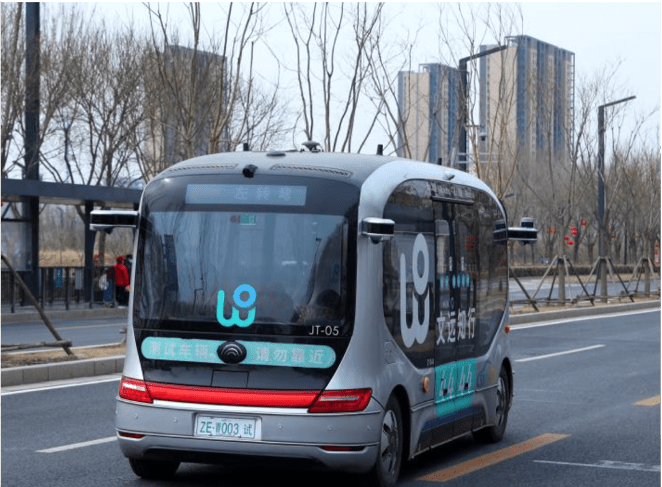
Beijing self-driving cars on the road will usher in legislative protection. Recently, the Beijing Municipal Bureau of Economy and Information Technology solicited comments on the "Beijing Autonomous Vehicle Regulations (Draft for Comment)". The city intends to support the use of autonomous vehicles for urban public electric bus passenger transport, online car booking, car rental and other urban travel services. In addition to application scenarios, the draft for comments also standardizes autonomous driving innovation from many aspects, such as whether there is a driver, how to deal with traffic problems, and so on. The release of the opinion draft also means that the commercialization of automatic driving is accelerating, and perhaps soon we will be able to experience the convenience of automatic driving. In addition, the accelerated pace of autonomous driving, and whether it will have an impact on the taxi and traditional network car industry, it is also worth thinking about.
Insurers fret over militant attacks, AI hacks at Paris Olympics
LONDON, July 5 (Reuters) - Insurers are nervous that militant attacks or AI-generated fake images could derail the Paris Olympics, risking event cancellations and millions of dollars in claims. Insurers faced losses after the 2020 Tokyo Olympics were postponed for a year due to the COVID-19 pandemic. Since then, wars in Ukraine and Gaza and a spate of elections this year, including in France, have driven up fears of politically-motivated violence at high-profile global events. The Olympics take place in Paris from July 26-Aug 11 and the Paralympics from Aug 28-Sept 8. German insurer Allianz (ALVG.DE), opens new tab is insurance partner for the Games. Other insurers, such as the Lloyd's of London (SOLYD.UL) market, are also providing cover. "We are all aware of the geopolitical situation the world is in," said Eike Buergel, head of Allianz's Olympic and Paralympic programme. "We are convinced that the IOC (International Olympic Committee), Paris 2024 and the national organising committees, together with the French authorities, are taking the right measures when it comes to challenges on the ground."
Exclusive: Japan must strengthen NATO ties to safeguard global peace, PM says
TOKYO, July 9 (Reuters) - Russia's deepening military cooperation with North Korea has underlined the need for Japan to forge closer ties with NATO as regional security threats become increasingly intertwined, Prime Minister Fumio Kishida told Reuters. In written remarks ahead of his attendance at a NATO summit in Washington DC this week, Kishida also signalled concern over Beijing's alleged role in aiding Moscow's two-year-old war in Ukraine, although he did not name China. "The securities of the Euro-Atlantic and the Indo-Pacific are inseparable, and Russia’s aggression against Ukraine and its deepened military cooperation with North Korea are strong reminders of that," Kishida said. "Japan is determined to strengthen its cooperation with NATO and its partners," he added. The world, the Japanese leader said, should not tolerate attempts by some countries to disrupt the established international order and reiterated a warning that Ukraine today could be East Asia tomorrow. He also urged cooperation to confront new security threats that transcend geographical boundaries, such as cyber-attacks and conflicts in space. The U.S. and its allies have accused Pyongyang of providing ballistic missiles and artillery shells that Russia has used in its war in Ukraine and say they fear Moscow in return could provide support for North Korea's nuclear missile development. Washington has also said China is supplying droneWithout naming China, Kishida told Reuters "some countries" have allegedly transferred dual-use civilian-military goods to Russia which has served "as a lifeline" for its Ukraine war. "It is necessary to grapple with such situations in a multi-faceted and strategic manner, taking a panoramic view that considers the full range of international actors fuelling Russia’s attempt to change the status quo by force," he said. "The geographical boundary of 'Euro-Atlantic' or 'Indo-Pacific' is no longer relevant in safeguarding global peace and security. Japan and Indo-Pacific partners can play a great role for NATO allies from this perspective." Constrained by decades of pacifism, Tokyo has been reluctant to supply lethal aid to Ukraine. It has, however, provided financial aid to Kyiv, spearheaded efforts to prepare for its post-war reconstruction, and contributed to NATO’s fund to provide Ukraine with non-lethal equipment such as anti-drone detection systems. Tokyo has also repeatedly warned about the risks of a similar conflict emerging in East Asia, where China has been taking an increasingly muscular stance towards its territorial claims including the democratic island of Taiwan. "This summit is a critical opportunity for Japan, the U.S., and the other NATO allies to confront the ongoing challenges against the international order and to reaffirm values and principles that have shaped global peace and prosperity," he said. There may be limits, however, over how far NATO members are prepared to go in forging closer ties in Asia. A plan that surfaced last year for NATO to open a liaison office in Japan, its first in Asia, was blocked by France and criticised by China. and missile technology, satellite imagery and machine tools to Russia, items which fall short of lethal assistance but are helping Moscow build its military to sustain the Ukraine war. Beijing has said it has not provided any weaponry to any party.