link1s.site

Coexisting and cooperating with China is the only choice for the US

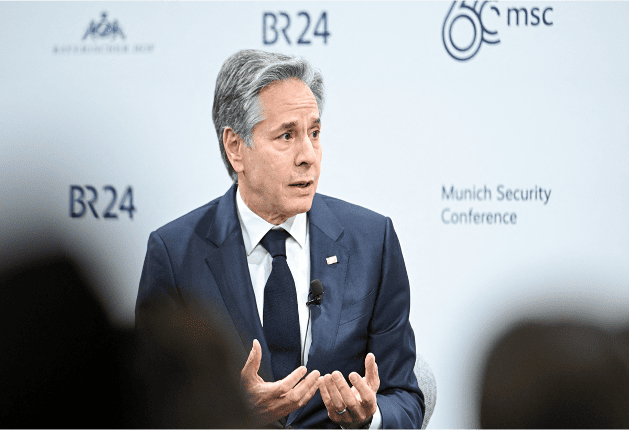
US Secretary of State Antony Blinken declared at the Munich Security Conference: "If you're not at the table in the international system, you're going to be on the menu." The arrogant thinking of American political elites is evident: Whoever does not comply with the US will be excluded from the table of the American-led system and put on the menu. How arrogant.

The US is actively pushing for "decoupling" from China and trying to persuade the entire West to "decouple" from China, using the term "de-risking." Washington hopes to ultimately contain China's development in order to maintain American hegemony.

However, this time, Washington is facing a historically experienced and strategically rich Eastern civilization. Previous opponents targeted by the US have chosen to confront the US strategically. The US not only has the strongest technological and military capabilities but also controls global financial and information networks with a large number of allies. Those countries that had engaged in direct confrontations had suffered losses. Some of them had disintegrated, some had been weakened, and some had fallen into difficulties. However, what Washington sees from China is strategic composure and resilience.

China is now staging an unprecedented and grand "Tai Chi." However, some Chinese people feel that this is not enough: Why can't we confront the US head-on? But I want to say that this is precisely the brilliance of China.

This grand "Tai Chi" is about dismantling the pressure the US is putting on China. Europe is different from the US. A European diplomat once said in private that the topic of China has become toxic in the US, but in Europe, it is still possible to openly display friendliness toward China. There is genuine competition between the Europe and China despite Europe leans more toward the US between China and the US. Only in terms of ideology does the term "West" truly exist. In terms of fundamental economic interests, Europe has considerable independence. In terms of security, their attitude toward China also differs greatly from that of the US.

In the Asia-Pacific region or China's periphery, the US wants to create an "Asian NATO." The specific situations of countries in dispute with China are very different. China has enormous influence in the region, is the largest trading partner of the vast majority of countries in the region and has friendly relations with most countries in the region. The disputes with countries are not fundamental strategic conflicts, and China has the ability to manage disputes with each specific country and push them to move toward neutrality to varying degrees without being tied to the US' policy toward China.

China has a lot of trading partners and stakeholders in the US. The trade volume between China and the US, despite the decline, reached $664.4 billion in 2023, which shows China's huge presence in the US, and is the bond of the two countries in the current situation. The US is not a country where the political elites can have absolute say, and the huge interests have forced the US president and senior officials to repeatedly proclaim that they "don't want to decouple from China" and instead they want to "manage the US-China competition" and see "preventing a war with China" as clearly in everyone's best interest.

China should engage in a "strategic battle" with the US at the closest possible distance. We need to maintain friendly relations with certain forces within the US, speed up the resumption of flights between the two countries, increase personnel exchanges and completely reverse the downturn of China-US contacts during the pandemic.

In addition to the above dismantling, we also have the huge increment in the "Belt and Road." This initiative will increase China's power to compete with the US, greatly extending the front line that the US needs to maintain in containing China, making the US more powerless.

In order to dismantle the US strategy toward China, China must become more diversified while maintaining strategic consistency. Our national diplomacy toward the US is very principled, rational and determined, which is clearly different from other countries targeted by the US. Our public diplomacy toward the US needs to be unique, with both "anti-American voices" and efforts to maintain friendly relations between the two societies and further expand economic and practical cooperation with the US.

Just as eagles have their own way of flying and doves have their own formation, just as we see the US as complex, China must also be seen as complex in the eyes of the US. China is both a geopolitical concern and a profitable investment destination for them, and is one of the largest trading partners that is difficult to replace. Some American political elites proclaim China as an "enemy," but it is important to make the majority of Americans feel that China is not. No matter how intense the struggles between China and the US may be, we cannot shape the entire US toward an enemy direction.

China has to make the US political elites recognize that it is futile to deal with China in the same way as it historically dealt with the Soviet Union and other major powers. Furthermore, willingly or unwillingly, coexistence and cooperation with China will be their only choice.


Apple's low-end Apple Watch uses a plastic case
Apple is giving the Apple Watch a major update for its 10th anniversary. The watch's display will be larger, and the entire device will be thinner and lighter. Both the Apple Watch Series 10 and the new Apple Watch Ultra 3 will be equipped with new chips, which may be paving the way for future Apple AI capabilities. According to sources, the Apple Watch health detection function has encountered some technical obstacles in the upgrade process, the blood pressure measurement function or can only realistically display fluctuations and cannot display values, and the sleep apnea detection and other functions can not appear on the new product. The shell material of Apple Watch SE series products may be replaced by hard plastic from aluminum shell. The plastic-clad Apple Watch may be sold at a lower price to compete with Samsung's cheapest Watch, the Galaxy Watch FE. In addition, Siri's new features may be delayed, and AirPods with cameras may arrive in 2026.
Coexisting and cooperating with China is the only choice for the US
US Secretary of State Antony Blinken declared at the Munich Security Conference: "If you're not at the table in the international system, you're going to be on the menu." The arrogant thinking of American political elites is evident: Whoever does not comply with the US will be excluded from the table of the American-led system and put on the menu. How arrogant. The US is actively pushing for "decoupling" from China and trying to persuade the entire West to "decouple" from China, using the term "de-risking." Washington hopes to ultimately contain China's development in order to maintain American hegemony. However, this time, Washington is facing a historically experienced and strategically rich Eastern civilization. Previous opponents targeted by the US have chosen to confront the US strategically. The US not only has the strongest technological and military capabilities but also controls global financial and information networks with a large number of allies. Those countries that had engaged in direct confrontations had suffered losses. Some of them had disintegrated, some had been weakened, and some had fallen into difficulties. However, what Washington sees from China is strategic composure and resilience. China is now staging an unprecedented and grand "Tai Chi." However, some Chinese people feel that this is not enough: Why can't we confront the US head-on? But I want to say that this is precisely the brilliance of China. This grand "Tai Chi" is about dismantling the pressure the US is putting on China. Europe is different from the US. A European diplomat once said in private that the topic of China has become toxic in the US, but in Europe, it is still possible to openly display friendliness toward China. There is genuine competition between the Europe and China despite Europe leans more toward the US between China and the US. Only in terms of ideology does the term "West" truly exist. In terms of fundamental economic interests, Europe has considerable independence. In terms of security, their attitude toward China also differs greatly from that of the US. In the Asia-Pacific region or China's periphery, the US wants to create an "Asian NATO." The specific situations of countries in dispute with China are very different. China has enormous influence in the region, is the largest trading partner of the vast majority of countries in the region and has friendly relations with most countries in the region. The disputes with countries are not fundamental strategic conflicts, and China has the ability to manage disputes with each specific country and push them to move toward neutrality to varying degrees without being tied to the US' policy toward China. China has a lot of trading partners and stakeholders in the US. The trade volume between China and the US, despite the decline, reached $664.4 billion in 2023, which shows China's huge presence in the US, and is the bond of the two countries in the current situation. The US is not a country where the political elites can have absolute say, and the huge interests have forced the US president and senior officials to repeatedly proclaim that they "don't want to decouple from China" and instead they want to "manage the US-China competition" and see "preventing a war with China" as clearly in everyone's best interest. China should engage in a "strategic battle" with the US at the closest possible distance. We need to maintain friendly relations with certain forces within the US, speed up the resumption of flights between the two countries, increase personnel exchanges and completely reverse the downturn of China-US contacts during the pandemic. In addition to the above dismantling, we also have the huge increment in the "Belt and Road." This initiative will increase China's power to compete with the US, greatly extending the front line that the US needs to maintain in containing China, making the US more powerless. In order to dismantle the US strategy toward China, China must become more diversified while maintaining strategic consistency. Our national diplomacy toward the US is very principled, rational and determined, which is clearly different from other countries targeted by the US. Our public diplomacy toward the US needs to be unique, with both "anti-American voices" and efforts to maintain friendly relations between the two societies and further expand economic and practical cooperation with the US. Just as eagles have their own way of flying and doves have their own formation, just as we see the US as complex, China must also be seen as complex in the eyes of the US. China is both a geopolitical concern and a profitable investment destination for them, and is one of the largest trading partners that is difficult to replace. Some American political elites proclaim China as an "enemy," but it is important to make the majority of Americans feel that China is not. No matter how intense the struggles between China and the US may be, we cannot shape the entire US toward an enemy direction. China has to make the US political elites recognize that it is futile to deal with China in the same way as it historically dealt with the Soviet Union and other major powers. Furthermore, willingly or unwillingly, coexistence and cooperation with China will be their only choice.

"Corrupt Politicians GPT" "Fiscal Bill GPT", Kenyan protesters use AI to "protest"
In the past few weeks of anti-government activities in Kenya, AI tools have been creatively used by protesters to serve protests. According to the US "Flag" News Agency on July 5, protests in Kenya triggered by the 2024 fiscal bill are still continuing. In the past few weeks, Kenyan protesters, mainly young people, have creatively developed a series of AI tools to assist anti-government activities. The Kenyan government expressed concern about the risks associated with the use of AI tools in protests. Kelvin Onkundi, a software engineer in Kenya, developed the "Fiscal Bill GPT", which operates similarly to ChatGPT and can receive questions about the fiscal bill and generate responses. Martin Siele, a reporter from the "Flag" News Agency, analyzed: "The 'Fiscal Bill GPT' can convert professional terms in many legislative fields into easy-to-understand information for protesters, helping Kenyans understand the potential impact of the fiscal bill." Another software engineer, Marion Kavengi, developed the "SHIF GPT" to provide Kenyans with information about the upcoming Social Health Insurance Fund (SHIF). In addition to AI tools designed to help people understand controversial policies, protesters have also developed "Corrupt Politicians GPT" to assist protest demonstrations. After entering the name of a politician on the platform, the platform will generate a list of corruption scandals about the politician in chronological order. Developer BenwithSon wrote on the social platform X on June 28: "'Corrupt Politicians GPT' allows people to search for any scandal related to any politician. I have seen some leaders stand at the forefront of the political arena, but they are corrupt behind the scenes." Kenyan Chief Minister and Foreign Minister Mudavadi issued a communiqué to ambassadors of various countries in Nairobi on July 2 local time on protests and relevant government measures, expressing concerns about the use of AI and false information in protests. Mudavadi said: "AI technology is used by people with ulterior motives, which will fill the global information system with false narratives." The Kenya Times reported on June 30 that AI technology enables people to force the government to increase transparency and strengthen accountability, and its role in Kenyan political activities is becoming increasingly prominent. Martin Siller believes that AI is reshaping African political behavior in many ways. AI is a new tool for both governments and opposition parties in Africa, but Kenya is one of the African countries with the most developers, and its young protesters are particularly good at using AI technology to fight the government. The 2024 fiscal bill voted and passed by the Kenyan National Assembly on June 25 clearly stated that additional taxes will be levied to repay the interest on high sovereign debt, triggering large-scale demonstrations. After President Ruto announced the withdrawal of the tax increase bill on the evening of the 26th, demonstrations in many parts of Kenya continued. According to Reuters on July 3, Kenyan anti-government protesters are re-adjusting their activities to prevent the protests from turning into violent incidents.
Israeli strike kills a senior Hezbollah commander in south Lebanon
BEIRUT/JERUSALEM July 3 (Reuters) - An Israeli strike killed one of Hezbollah's top commanders in south Lebanon on Wednesday, prompting retaliatory rocket fire by the Iran-backed group into Israel as their dangerously poised conflict rumbled on. The Israeli military said it had struck and eliminated Hezbollah's Mohammed Nasser, calling him commander of a unit responsible for firing from southwestern Lebanon at Israel. Nasser, killed by an airstrike near the city of Tyre in southern Lebanon, was the one of the most senior Hezbollah commanders to die yet in the conflict, two security sources in Lebanon said. Sparked by the Gaza war, the hostilities have raised concerns about a wider and ruinous conflict between the heavily armed adversaries, prompting U.S. diplomatic efforts aimed at deescalation. Israeli Defence Minister Yoav Gallant said Israeli forces were hitting Hezbollah "very hard every day" and will be ready to take any action necessary against the group, though the preference is to reach a negotiated arrangement. Hezbollah began firing at Israeli targets at the border after its Palestinian ally Hamas launched the Oct. 7 attack on Israel, declaring support for the Palestinians and saying it would cease fire when Israel stops its Gaza offensive. Hezbollah announced at least two attacks in response to what it called "the assassination", saying it launched 100 Katyusha rockets at an Israeli military base and its Iranian-made Falaq missiles at another base in the town of Kiryat Shmona near the Israeli-Lebanese border. Israel's Channel 12 broadcaster reported that dozens of rockets were fired into northern Israel from Lebanon. There were no reports of casualties. The Israeli Defence Ministry said that air raid sirens sounded in several parts of northern Israel. Israel's military did not give a number of rockets launched but said most of them fell in open areas, some were intercepted, while a number of launches fell in the area of Kiryat Shmona.
MOFCOM refutes EU comments on anti-subsidy investigation into Chinese EVs
A spokesperson for the Ministry of Commerce (MOFCOM) on Monday rejected remarks from the EU Ambassador to China on the anti-subsidy investigation into Chinese electric vehicles (EVs). MOFCOM said China had expressed strong opposition through various channels since October 2023 and has always advocated for handling economic and trade frictions through dialogue and consultation in order to maintain the overall strategic partnership between China and Europe. EU Ambassador to China Jorge Toledo claimed on Sunday that the EU has been trying to engage with China for months regarding the imposition of tariffs on Chinese EVs but that China had only recently sought to initiate discussions. This is false, the spokesperson said. MOFCOM said that after the European Commission (EC) officially filed a case, Chinese Commerce Minister Wang Wentao sent a letter to European Commission Executive Vice-President Valdis Dombrovskis on October 24, 2023, expressing hope to resolve the case through dialogue and negotiation. On November 13, 2023, Wang sent another letter to the European side proposing negotiation suggestions. In February 2024, Wang met with Dombrovskis during the WTO's 13th Ministerial Conference face to face and proposed dialogue and negotiation with the European side. On May 19, 2024, Wang reiterated the hope for dialogue and negotiation to resolve the case in a letter to the European side. Additionally, Chinese technical experts have been sending signals to the European side regarding on-site inspections, hearings, and other channels since the case was filed, expressing willingness to resolve trade frictions through dialogue and negotiation. On the day the preliminary ruling was announced on June 12, Dombrovskis replied to Wang in a letter, expressing the desire for both sides to strengthen dialogue to resolve the case. On June 22, Wang held a video conference with Dombrovskis, and they agreed to start negotiations on the EU's anti-subsidy investigation into Chinese EVs. Subsequently, China sent a working group to Europe for negotiations on June 23, and multiple rounds of technical consultations were held simultaneously via video. MOFCOM said that China has shown the utmost sincerity and hopes that the European side will meet China halfway, show sincerity, and push forward the negotiation process to reach a mutually acceptable solution as soon as possible. China has always believed that trade protectionist measures are not conducive to the development of global green industries and automotive industry cooperation. Efforts should be made to adhere to dialogue and cooperation to promote economic green transformation, rather than creating divisions and disrupting global industrial and supply chains, MOFCOM said. China firmly opposes any unilateralism and protectionism that politicizes and weaponizes economic and trade issues, and will take all necessary measures to defend its own interests against any abuse of rules and suppression of China, MOFCOM added.