link1s.site

MOFCOM refutes EU comments on anti-subsidy investigation into Chinese EVs

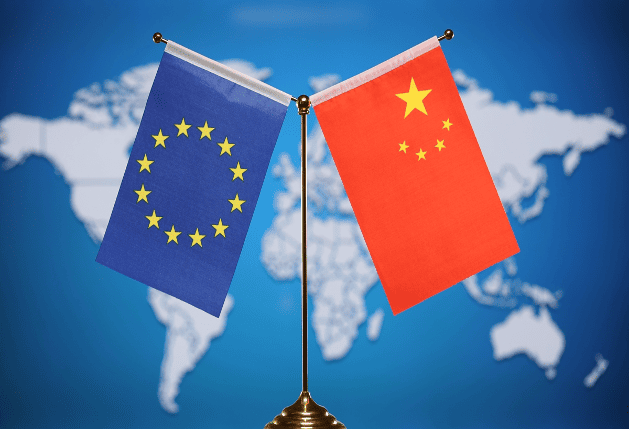
A spokesperson for the Ministry of Commerce (MOFCOM) on Monday rejected remarks from the EU Ambassador to China on the anti-subsidy investigation into Chinese electric vehicles (EVs).

MOFCOM said China had expressed strong opposition through various channels since October 2023 and has always advocated for handling economic and trade frictions through dialogue and consultation in order to maintain the overall strategic partnership between China and Europe.

EU Ambassador to China Jorge Toledo claimed on Sunday that the EU has been trying to engage with China for months regarding the imposition of tariffs on Chinese EVs but that China had only recently sought to initiate discussions. This is false, the spokesperson said.

MOFCOM said that after the European Commission (EC) officially filed a case, Chinese Commerce Minister Wang Wentao sent a letter to European Commission Executive Vice-President Valdis Dombrovskis on October 24, 2023, expressing hope to resolve the case through dialogue and negotiation.

On November 13, 2023, Wang sent another letter to the European side proposing negotiation suggestions.

In February 2024, Wang met with Dombrovskis during the WTO's 13th Ministerial Conference face to face and proposed dialogue and negotiation with the European side.

On May 19, 2024, Wang reiterated the hope for dialogue and negotiation to resolve the case in a letter to the European side.

Additionally, Chinese technical experts have been sending signals to the European side regarding on-site inspections, hearings, and other channels since the case was filed, expressing willingness to resolve trade frictions through dialogue and negotiation.

On the day the preliminary ruling was announced on June 12, Dombrovskis replied to Wang in a letter, expressing the desire for both sides to strengthen dialogue to resolve the case.

On June 22, Wang held a video conference with Dombrovskis, and they agreed to start negotiations on the EU's anti-subsidy investigation into Chinese EVs.

Subsequently, China sent a working group to Europe for negotiations on June 23, and multiple rounds of technical consultations were held simultaneously via video.

MOFCOM said that China has shown the utmost sincerity and hopes that the European side will meet China halfway, show sincerity, and push forward the negotiation process to reach a mutually acceptable solution as soon as possible.

China has always believed that trade protectionist measures are not conducive to the development of global green industries and automotive industry cooperation. Efforts should be made to adhere to dialogue and cooperation to promote economic green transformation, rather than creating divisions and disrupting global industrial and supply chains, MOFCOM said.

China firmly opposes any unilateralism and protectionism that politicizes and weaponizes economic and trade issues, and will take all necessary measures to defend its own interests against any abuse of rules and suppression of China, MOFCOM added.

SpaceX astronaut returns with an incredible change in his body
A provocative new study reveals the complex effects of the space environment on human health, providing insight into potential damage to blood, cell structure and the immune system. The study focused on SpaceX's Inspiration4 mission, which successfully sent two men and two women into space in 2021 to orbit the Earth for three days and shed some light on the effects of space travel on the human body. The research data, derived directly from the Inspiration4 mission, shows that even a brief trip to space can significantly damage the human immune system, trigger an inflammatory response, and profoundly affect cell structure. In particular, space travel triggered unprecedented changes in cytokines that play a key role in immune response and muscle regulation but are not usually directly associated with inflammation. In particular, the study found a significant increase in muscle factors, which are physiological responses specific to skeletal muscle cells in microgravity, rather than a simple immune response. Although non-muscular tissues did not show changes in proteins associated with inflammation, specific leg muscles such as soleus and tibialis anterior muscles showed significant signs of metabolic activity, especially increased interleukin in the latter, further enhancing the activation of immune cells.
Morning Bid: Eyes switch to inflation vs elections, Powell up
A look at the day ahead in U.S. and global markets from Mike Dolan After an intense month focused on election risk around the world, markets quickly switched back to the more prosaic matter of the cost of money - and whether disinflation is resuming to the extent it allows borrowing costs to finally fall. Thursday's U.S. consumer price update for June is the key moment of the week for many investors - with the headline rate expected to have fallen two tenths of a percentage point to 3.1% but with 'core' rates still stuck at 3.4%. With Federal Reserve chair Jerome Powell starting his two-pronged semi-annual congressional testimony later on Tuesday, the consensus CPI forecast probably reflects what the central bank thinks of the situation right now - encouraging but not there yet. But as the U.S. unemployment rate is now back above 4.0% for the first time since late 2021, markets may look for a more nuanced approach from the Fed chair that sees it increasingly wary of a sudden weakening of the labor market as real time quarterly GDP estimates ebb again to about 1.5%. There were some other reasons for Fed optimism in the lead up to the testimony. The path U.S. inflation is expected to follow over coming years generally softened in June, amid retreating projections of price increases for a wide array of consumer goods and services, a New York Fed survey showed on Monday. Inflation a year from now was seen at 3% as of June - down from the expected rise of 3.2% in May - and five-year expectations fell to 2.8% from 3%. Crude oil prices are better behaved this week, too, falling more than 3% from the 10-week highs hit late last week and halving the annual oil price gain to 10%. The losses on Tuesday came after a hurricane that hit a key U.S. oil-producing hub in Texas caused less damage than many in markets had expected - easing concerns over supply disruption. Before Powell starts speaking later, there will also be an update on U.S. small business confidence for last month.
It may be getting harder to leave your smart wearable for the sake of your health
The world's first portable electrocardiograph was an 85-pound backpack, and now a 10-gram patch attached to your chest can transmit electrocardiograms uninterrupted for two weeks. The Apple Watch, which is worn by an estimated 100 million people, can send a text message to alert people when their heartbeat is irregular. Wearable sensors on the arms, wrists and fingers can now report arrhythmias, blood sugar levels, blood oxygen and other health indicators. Medical journals have also proposed a more ambitious vision - wearable devices can monitor patients with chronic diseases, eliminating the need for frequent hospital visits. They can spot potential health problems before a stroke or diabetes develops. The forces of health technology and wearables are converging. Tech giants like Apple (AAPL) and Alphabet's (GOOGL) Google are adding health features to their products. Medical technologists like electrocardiogram patch maker iRhythm Technologies or blood sugar monitor makers DexCom (DXCM) and Abbott Laboratories (ABT) are taking their devices beyond the clinic. "In the sensor world, people started on the consumer side and wanted to get into health care," said Kevin Sayer, chief executive of Decon Medical. "In health care, we're trying to be more consumer oriented, and I think all of those things are sort of colliding." Early bets favored the tech giants, with every health-related announcement from Apple, Google or Samsung Electronics hitting medical tech stocks. But changing doctors' practices will also require sustained investment in clinical trials. Big tech companies have cut back on investments in health care. Now it seems that medical technologists will be at the vanguard of the digital health revolution - with smartwatches and smart rings bringing them more customers who need to be diagnosed. Blake Goodner, co-founder of Bridger Management, a hedge fund focused on health care, said: "A group of medtech companies focused on digital health are maturing and reaching a scale where they can not only be profitable but also make investments to compete with larger tech companies." Tech giants aren't getting out of the health business. Apple's smartwatch has an electronic heart rate sensor that generates a single-point electrocardiogram, a wrist temperature sensor, and an accelerometer that can detect violent falls. Hundreds of millions of people are wearing smartwatches with health features from Apple or its rivals Samsung and Garmin.
Ukrainian Presidential Office: Russia's attacks on multiple locations in Ukraine have killed 36 people
The Ukrainian presidential office said on July 8 local time that Russia's large-scale attacks on many parts of Ukraine have killed 36 people and injured 140 others. According to the Ukrainian State Emergency Service, a total of 619 rescue workers and 132 equipment participated in the rescue work across Ukraine that day. Ukrainian President Zelensky said on social media on the 8th that Russia launched more than 40 missiles of various types at Ukraine that day. Residential buildings and infrastructure in many cities in Ukraine were damaged in varying degrees of attacks, and a children's hospital was destroyed. Rescue departments are currently conducting emergency rescue on the scene. The Russian Ministry of Defense issued a statement on the 8th local time saying that Ukrainian officials' claim that Russia used missiles to attack Ukrainian civilian facilities was untrue. The damage suffered by Kiev was caused by the fall of missiles launched by the city's air defense system.
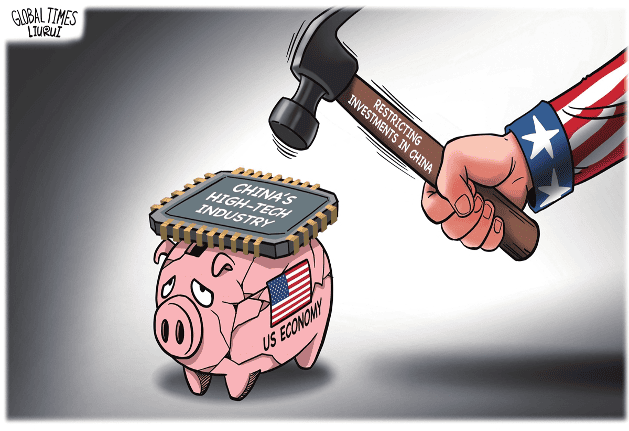
US' ban on high-tech investment cannot stifle China's high-tech development
US President Joe Biden signed an executive order on Wednesday restricting investments in China, intended to further stymie China's advances in three cutting-edge technology areas: semiconductors and microelectronics, quantum information technologies and certain artificial intelligence systems. The "decoupling" of high tech from China began under Donald Trump, and the Biden administration has continued that ambition. However, the new order doesn't target US investments already invested in China, but the new ones. The Biden administration has repeatedly claimed that the US restrictions will be narrowly targeted and will not "have a fundamental impact on affecting the investment climate for China." Biden's new executive order is still subject to consultation with the US business community and the public and is not expected to take effect until next year. The order has been brewed for a long time and has generated a lot of publicity. But almost no one believes that this executive order will deal a new practical blow to Chinese high technology, because almost everyone knows that China needs American technology more than American money. The order has gained much attention because it is seen as part of a broader trend of the US drifting away from China. The promulgation and brewing process of the executive order reflects the strong desire of American political elites to suppress China's high-tech development, as well as a fierce game between those supporting the executive order and the concerns of the technology and economic sectors about a potential backfire on the US. It is a kind of compromise. Washington obviously hopes that major allies will follow Biden's executive order. The UK's Sunak government has made cautious statements, stating that it is consulting business and the financial sector before deciding whether to follow suit. In fact, China also has the ability to influence the extent to which Biden's executive order is implemented, as well as the extent to which the US will go in terms of "decoupling" from China. We are definitely not just passive recipients of US policies. American political elites are eager to "decouple" from China as quickly and deeply as possible, but they fear two things: First, this will immediately damage the performance of relevant high-tech companies in the US, undermine their influence and further innovation. The current Biden administration, in particular, does not want to incur strong resentment from Silicon Valley and Wall Street toward the escalating "decoupling," which will ultimately lead to the loss of support for the Democratic Party. Second, they are afraid of pushing China toward more resolute independent innovation to achieve breakthroughs in key technologies such as chips. If the US "decoupling" policy gives birth to major technological achievements in China, it means that Washington will completely lose the gamble: They originally wants to stifle China's high-tech development, but ends up strangling their own companies. What China needs to do next is to fully unleash our innovation vitality, continuously reduce our dependence on high-tech products from the US, and prove that as long as we are determined to achieve independent innovation, we have the ability to accomplish things. We need to prove that being pressured by the US will only make us stronger. As long as there are several solid proofs of this trend, the US policy community will fall into unprecedented chaos, and their panic will be much more severe than when they saw the rapid expansion of the Chinese economy before Trump started the trade war. Regardless of the future of China-US relations, the current battle will be the key battle that determines the future competition between China and the US. China can only win and cannot afford to lose. High-tech products such as chips are not isolated. The innovation power of China's entire manufacturing industry and the creative vitality of the whole society are the foundation for shaping these key achievements. When pressured by the US, our society needs to generate confidence and resilience from all directions, and we need to accelerate and seize every opportunity, rather than shrink and simply defend. Otherwise, the US will gain the upper hand in momentum, and we will truly be in a passive and defensive position. We must see that the US is on the offensive, but its offensive is becoming weaker and weaker, and it is always hesitant with each step. What is presented to China are difficulties and risks, but also the dawn of victory.