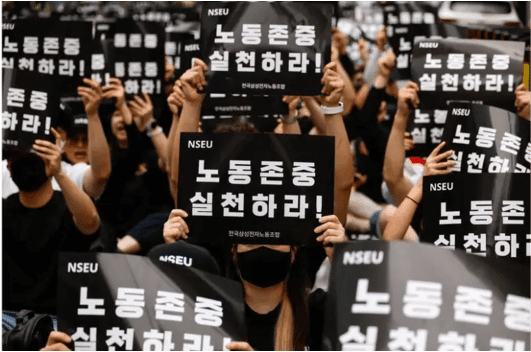
Samsung hit the biggest strike! Over 6,500 people attended.
More than 6,500 employees at South Korea's Samsung Electronics began a three-day mass strike on Monday (July 8), demanding an extra day of paid annual leave, higher pay raises and changes to the way performance bonuses are currently calculated. This is the largest organized strike in Samsung Electronics' more than half century of existence, and the union said that if this strike does not push employees' demands to be met, a new strike may be called. One of the core issues of the current dispute between the labor union and Samsung Electronics is raising wages and increasing the number of paid vacation days. The second demand is a pay rise. The union originally wanted a pay rise of more than 3% for its 855 employees, but last week they changed their demand to include all employees (rather than just 855). The third issue involves performance bonuses linked to Samsung's outsized profits - chip workers did not receive the bonuses last year when Samsung lost about Won15tn and, according to unions, fear they will still not get the money even if the company manages to turn around this year.

Morning Bid: Eyes switch to inflation vs elections, Powell up
A look at the day ahead in U.S. and global markets from Mike Dolan After an intense month focused on election risk around the world, markets quickly switched back to the more prosaic matter of the cost of money - and whether disinflation is resuming to the extent it allows borrowing costs to finally fall. Thursday's U.S. consumer price update for June is the key moment of the week for many investors - with the headline rate expected to have fallen two tenths of a percentage point to 3.1% but with 'core' rates still stuck at 3.4%. With Federal Reserve chair Jerome Powell starting his two-pronged semi-annual congressional testimony later on Tuesday, the consensus CPI forecast probably reflects what the central bank thinks of the situation right now - encouraging but not there yet. But as the U.S. unemployment rate is now back above 4.0% for the first time since late 2021, markets may look for a more nuanced approach from the Fed chair that sees it increasingly wary of a sudden weakening of the labor market as real time quarterly GDP estimates ebb again to about 1.5%. There were some other reasons for Fed optimism in the lead up to the testimony. The path U.S. inflation is expected to follow over coming years generally softened in June, amid retreating projections of price increases for a wide array of consumer goods and services, a New York Fed survey showed on Monday. Inflation a year from now was seen at 3% as of June - down from the expected rise of 3.2% in May - and five-year expectations fell to 2.8% from 3%. Crude oil prices are better behaved this week, too, falling more than 3% from the 10-week highs hit late last week and halving the annual oil price gain to 10%. The losses on Tuesday came after a hurricane that hit a key U.S. oil-producing hub in Texas caused less damage than many in markets had expected - easing concerns over supply disruption. Before Powell starts speaking later, there will also be an update on U.S. small business confidence for last month.

Amid rising regional tensions, the US announced that it will hold another Rim of the Pacific military exercise
The U.S. Navy's Pacific Fleet announced on Wednesday (May 22) that the 2024 Rim of the Pacific Exercise (RIMPAC 2024) is expected to take place on June 26, with 29 countries participating in and around the Hawaiian Islands, a larger lineup than the previous exercise in 2022. The Philippines, which has had multiple maritime conflicts with China recently, and Japan, which has tense diplomatic relations with China, will send troops to participate. China has been excluded from participating in the international military exercise since 2018, and its aggressive actions and reactions are causing tensions in the Pacific region to continue to rise. The biennial Rim of the Pacific military exercise is the world's largest international maritime exercise. The U.S. Navy said that the exercise will last until August 2, and it is expected to involve 29 countries, 40 surface ships, 3 submarines, 14 countries' army forces, more than 150 aircraft and more than 25,000 personnel. The U.S. Navy said that the theme of the 29th RIMPAC 2024 is "Partners: Integrated and Ready", emphasizing inclusiveness as the core, promoting multinational cooperation and trust, and using military interoperability to achieve their respective national goals to strengthen integrated and ready alliance partners. Its goal is to "enhance collective strength and promote a free and open Indo-Pacific region" through joint training and operations. The 29 countries participating in the exercise this year include Australia, Belgium, Brazil, Brunei, Canada, Chile, Colombia, Denmark, Ecuador, France, Germany, India, Indonesia, Israel, Italy, Japan, Malaysia, Mexico, the Netherlands, New Zealand, Peru, South Korea, the Philippines, Singapore, Sri Lanka, Thailand, Tonga, the United Kingdom and the United States. Compared with the 28th RIMPAC held in 2022, which involved 26 countries, 38 surface ships, 4 submarines, 9 countries' army forces, more than 170 aircraft, and about 25,000 officers and soldiers, the number of countries, ships and army forces participating in this exercise has increased. The countries participating in this year's RIMPAC military exercise include all members of the Quadrilateral Security Dialogue (QUAD) between the United States, Japan, India and Australia, and the Australia-UK-US Trilateral Security Partnership (AUKUS), as in the previous exercise. In addition, countries surrounding the South China Sea and the South Pacific island nation of Tonga are also participating. Many analysts believe that the military exercise itself is sending a message to China: China's expansion in the Western Pacific region will be blocked and defeated. The United States invited China to participate in the RIMPAC military exercise twice in 2014 and 2016. In 2018, due to China's expansion in the South China Sea, the United States withdrew its invitation to China. In addition, despite Taiwan's repeated willingness to participate, Taiwan is still not included in the 29 countries participating in this year's RIMPAC military exercise. Analysts pointed out that the US-led RIMPAC military exercise is intended to unite allies to militarily intimidate China. If Taiwan is invited to join, it will be too provocative to China, which will not only aggravate the tension between the United States and China, but also embarrass some allies. The U.S. Navy said the commander of the U.S. Third Fleet will serve as the commander of the joint task force for the exercise, while Chilean Navy Commodore Alberto Guerrero will serve as deputy commander of the joint task force, which is a first in the history of the RIMPAC military exercise. In addition, Japan Maritime Self-Defense Force Rear Admiral Kazushi Yokota will also serve as deputy commander. Other key leaders of the multinational force exercise include Canadian Commodore Kristjan Monaghan, who will command the maritime forces, and Australian Air Force Commodore Louise Desjardins, who will command the air forces. According to the U.S. Stars and Stripes, Vice Admiral Michael Boyle is currently the commander of the U.S. Third Fleet. Vice Admiral John Wade has been nominated to replace Boyle. The U.S. Navy press release said the exercise will enhance the ability of international joint forces to "deter and defeat aggression by major powers in all domains and conflict levels," but did not provide specific information on which exercises will be held this summer. Previous RIMPAC training exercises have included sinking ships at sea with missiles, amphibious landings and the first landing of a Marine Corps Osprey aircraft on an Australian ship.
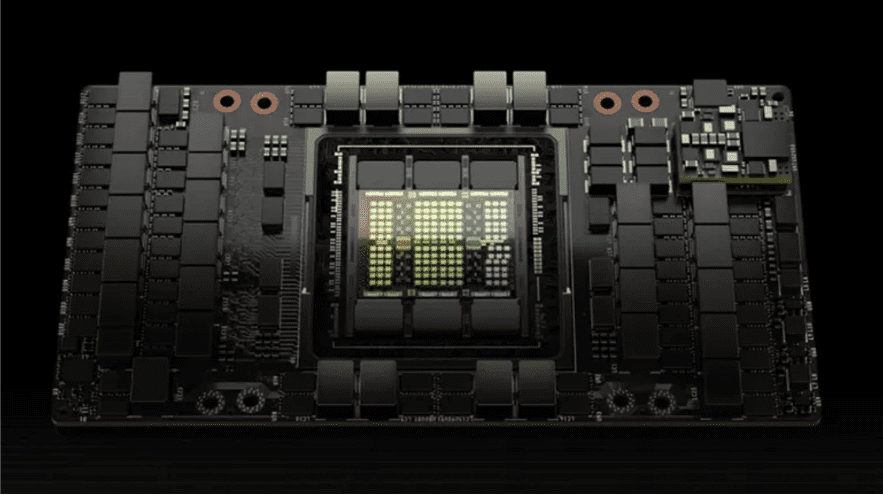
Nvidia H20 will sell 1 million units this year, contributing $12 billion in revenue!
Recently, according to the FT, citing the latest forecast data of the market research institute SemiAnalysis, AI chip giant NVIDIA will ship more than 1 million new NVIDIA H20 acceleration chips to the Chinese market this year, and it is expected that the cost of each chip is between $12,000 and $13,000. This is expected to generate more than $12 billion in revenue for Nvidia. Affected by the United States export control policy, Nvidia's advanced AI chip exports to China have been restricted, H20 is Nvidia based on H100 specifically for the Chinese market to launch the three "castration version" GPU among the strongest performance, but its AI performance is only less than 15% of H100, some performance is even less than the domestic Ascend 910B. When Nvidia launched the new H20 in the spring of this year, there were reports that due to the large castration of H20 performance, coupled with the high price, Chinese customers' interest in buying is insufficient, and they will turn more to choose China's domestic AI chips. Then there are rumors that Nvidia has lowered the price of the H20 in order to improve its competitiveness. However, the latest news shows that due to supply issues caused by the low yield of the Ascend 910B chip, Chinese manufacturers in the absence of supply and other better options, Nvidia H20 has started to attract new purchases from Chinese tech giants such as Baidu, Alibaba, Tencent and Bytedance. Analysts at both Morgan Stanley and SemiAnalysis said the H20 chip is now being shipped in bulk and is popular with Chinese customers, despite its performance degradation compared to chips Nvidia sells in the United States.

When Amazon also started upgrading "refund only"
Amazon official said that the freight from the Chinese warehouse will be lower than the traditional FBA(Fulfillment by Amazon) fee, similar to the domestic air delivery small package service, which will undoubtedly greatly reduce the logistics costs of sellers. In addition to logistics, Amazon is also responsible for promotion and traffic, of course, sellers can still independently carry out product advertising, pricing and promotion activities, to maintain the personalized and independent brand. Many industry insiders said that Amazon launched the "low-price store" move to fight China's cross-border e-commerce platforms Temu, Shein, AliExpress and so on. Although it provides another platform for China's e-commerce to go to sea, many sellers said that the cost of settling in Amazon cross-border e-commerce has become lower, and they have asked about the conditions of settling in, but the rules look down, in fact, it is not so friendly for sellers.