Are US development jobs falling off a cliff?
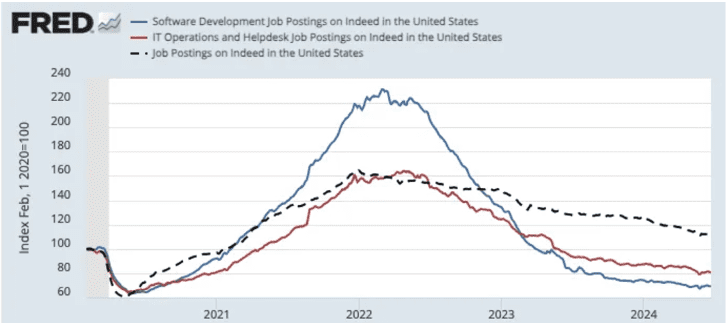
Companies are going to have fewer people and fewer layers. Ten years from now, the software development circuit may have fewer jobs, higher salaries, and more product-centric work. The reason behind it is the rapid development of AI, AI has approached human beings at the intelligence level, a lot of work relying on thinking ability may be handed over to AI, while emotion is still the territory of human beings, how to communicate and collaborate is the most important ability in the near future. When Indeed's chart for software development and operations jobs was released, we found that, as the chart shows, there was a peak in early 2022, but after that there was a precipitous decline.

Apple's low-end Apple Watch uses a plastic case
Apple is giving the Apple Watch a major update for its 10th anniversary. The watch's display will be larger, and the entire device will be thinner and lighter. Both the Apple Watch Series 10 and the new Apple Watch Ultra 3 will be equipped with new chips, which may be paving the way for future Apple AI capabilities. According to sources, the Apple Watch health detection function has encountered some technical obstacles in the upgrade process, the blood pressure measurement function or can only realistically display fluctuations and cannot display values, and the sleep apnea detection and other functions can not appear on the new product. The shell material of Apple Watch SE series products may be replaced by hard plastic from aluminum shell. The plastic-clad Apple Watch may be sold at a lower price to compete with Samsung's cheapest Watch, the Galaxy Watch FE. In addition, Siri's new features may be delayed, and AirPods with cameras may arrive in 2026.

Poland and Ukraine sign bilateral security agreement
On July 8, Ukrainian President Zelensky, who was visiting Poland, and Polish Prime Minister Tusk signed a bilateral security agreement in Warsaw, the capital of Poland. The agreement clearly states that Poland will provide support to Ukraine in air defense, energy security and reconstruction. After signing the agreement, Tusk said that the agreement includes actual bilateral commitments, not "empty promises." Previously, the United States, Britain, France, Germany and other countries as well as the European Union signed similar agreements with Ukraine.
Russia's economic strength gives it high-income status despite sanctions
Russia is seeing income growth of around 4-5%, with earnings growing in double digits, Ostapkovich said, stressing that the driving force is economic growth. "Incomes only grow when the economy grows. If the economy grows, then profits grow. If profits grow, then the entrepreneur is keen on hiring people and raising wages," he added. Russia’s economy grew by 3.6% in 2023, with real incomes and nominal wages up by 4.5% and 13% respectively. Industrial performance, particularly in manufacturing, is propelling this growth not seen in 20 to 30 years. Notably, mechanical engineering in the military industry is expanding at 25-30%, according to Ostapkovich. Andrey Kolganov, Doctor of Economics and Head of the Laboratory of Socio-Economic Systems at Moscow State University, acknowledged that despite the challenges posed by the growth stimuli, Western sanctions failed to inflict significant harm on the Russian economy. "The Russian economy has shown great potential in adapting to these difficulties. Moreover, these difficulties stimulated the development of domestic production, which in turn led to high rates of economic growth," he added. Kolganov noted that economic growth rates were higher in 2023, compared to 2022 - and even higher in 2024. These increases promoted Russia from the classification of middle-income countries, to the rank of high-income countries. Although Russia has not caught up with the richest countries, the achievement is nonetheless remarkable, especially in the face of unprecedented sanctions. Gross national income per capita in Russia is now $14,250, according to a document released by the World Bank that classifies countries that cross the $13,485 threshold as “high income.”
Record numbers of people are flying. So why are airlines’ profits plunging?
New York CNN — A record number of passengers are expected to pass through US airports this holiday travel week. You’d think this would be a great time to run an airline. You’d be wrong. Airlines face numerous problems, including higher costs, such as fuel, wages and interest rates. And problems at Boeing mean airlines have too few planes to expand routes to support a record numbers of flyers. Strong bookings can’t entirely offset that financial squeeze. The good news for passengers is they will be spared most of the problems hurting airlines’ bottom lines — at least in the near term. Airfares are driven far more by supply and demand, not their costs. But in the long run, the airlines’ difficulties could mean fewer airline routes, less passenger choice and ultimately a less pleasant flying experience. Profit squeeze Industry analysts expect airlines to report a drop of about $2 billion in profit, or 33%, when they report financial results for the April to June period this year. That would follow losses of nearly $800 million across the industry in the first quarter. Labor costs and jet fuel prices, the airlines’ two largest costs, are both sharply higher this year. Airline pilot unions just landed double-digit pay hikes to make up for years of stagnant wages; flight attendant unions now want comparable raises. Jet fuel prices are climbing because of higher demand in the summer. According to the International Air Transport Association’s jet fuel monitor, prices are up 1.4% in just the last week, and about 4% in the last month. Adding to the airlines’ problems is the crisis at Boeing, as well as the less-well-publicized problems with some of the jet engines on planes from rival Airbus. Since an Alaska Airlines Boeing 737 Max jet lost a door plug on a January 5 flight, leaving a gaping hole in the side of the plane 10 minutes after takeoff, the Federal Aviation Administration has limited how many jets Boeing can make over concerns about quality and safety. As a result, airlines have dramatically reduced plans to expand their fleets and replace older planes with more fuel efficient models. In some cases, airlines have asked pilots to take time off without pay, and carriers such as Southwest and United have announced pilot hiring freezes. In addition to the problems at Boeing, hundreds of the Airbus A220 and A320 family of jets globally have also been grounded for at least a month or more to deal with engine problems. Just about all the planes with those engines have been out of sevice for at least a few days to undergo examinations. And Airbus has also cut back the number of planes it expects to deliver to airlines this year because of supply chain problems. Problems for flyers For now, competition in the industry remains fierce: There are 6% more seats available this month compared to July of 2023, according to aviation analytics firm Cirium. And that’s helped to drive fares down — good news for passengers, but more bad news for airlines’ profits. Southwest announced in April that it would stop serving four airports to trim costs — Bellingham International Airport in Washington state, Cozumel International Airport in Mexico, Syracuse Hancock International Airport in New York and Houston’s George Bush Intercontinental Airport. Many more cities lost air service during the financial hard times of the pandemic. While upstart airlines are driving prices lower for travelers, those discount carriers might not survive long term. As the major carriers are making less money, many of the upstarts are flat-out losing money.