link1s.site

Exclusive: Nornickel in talks with China Copper to move smelting plant to China, sources say

HONG KONG, July 9 (Reuters) - Nornickel (GMKN.MM), opens new tab is in talks with China Copper to form a joint venture that would allow the Russian mining giant to move its entire copper smelting base to China, four sources with knowledge of the matter told Reuters.

If the move goes ahead, it would mark Russia's first uprooting of a domestic plant since the U.S. and Britain banned metal exchanges from accepting new aluminium, copper and nickel produced by Russia.

It also means Nornickel's copper will be produced within the country where it is most consumed.

Nornickel said in April it planned to close its Arctic facility and build a new plant in China with an unnamed partner.

Executives at China Copper, owned by the world's largest aluminium producer Chinalco (601600.SS), opens new tab, flew to Moscow in June to discuss a possible joint venture, one of the sources said, adding that details of the structure and investment are still under discussion.

Nornickel declined to comment. Chinalco and China Copper did not respond to requests for comment via email and phone.

Sites being considered in China include Fangchenggang and Qinzhou in the Guangxi region, the two sources said, with another source saying Qingdao in Shandong province was also possible.

A decision on a joint venture will be made over the next few months, a fifth source said, adding that Nornickel's Chinese output is likely to be consumed domestically.

The new facility will have capacity to produce 450,000 tonnes of copper annually, two of the sources said, amounting to around 2% of global mined supplies estimated at around 22 million metric tons this year.

Nornickel, which according to its annual report produced 425,400 tonnes of refined copper last year, processed all of its concentrates in 2023 at the Arctic plant, its only operation producing finished copper suitable for delivery to exchanges.

Avi Bruce appointed as head of IDF Central Command
On the evening of July 8, local time, the Israel Defense Forces issued a statement saying that Major General Avi Bluth replaced Yehuda Fox as the commander of the Israeli Central Command. Earlier that day, the Israeli army held a handover ceremony, which was presided over by the Israeli Chief of Staff Halevy. Avi Bluth joined the Israel Defense Forces in 1993 and commanded the Israeli military operations in the West Bank. In May this year, Bruce was promoted to major general and served as a military commander in the Israeli Central Command. CCTV reporters learned that in late April this year, Yehuda Fox, then commander of the Israeli Central Command, requested to resign and retire from the army in August this year. Fox had previously stated that he should bear part of the responsibility for the military intelligence failure on October 7 last year, and "must end his term like everyone else." According to the official website of the Israeli Defense Forces, the Central Command is one of the four major commands of the Israeli army, headquartered in Jerusalem, and its responsibility covers nearly one-third of Israel's territory.
US foreign policy is advanced smartphone with weak battery
A couple of days ago, a Quad summit meeting in Sydney scheduled for May 24 was abruptly canceled. The US president had to pull out of his long-anticipated trip to Australia and Papua New Guinea. Instead, the heads of the four Quad member states got together on the margins of the G7 Summit in Hiroshima on May 20. The main reason for the change of plans was the continuous struggle between the White House and Republicans on the Hill over the national debt ceiling. If no compromise is reached, the US federal government might fail to meet its financial commitments already in June; such a technical default would have multiple negative repercussions for the US, as well as for the global economy and finance at large. Let us hope that a compromise between the two branches of US power will be found and that the ceiling of the national debt will be raised once again. However, this rather awkward last-minute cancellation of the Quad summit reflects a fundamental US problem - a growing imbalance between the US geopolitical ambitions and the fragility of the national financial foundation to serve these ambitions. The Biden administration appears to be fully committed to bringing humankind back to the unipolar world that existed right after the end of the Cold War some 30 years ago, but the White House no longer has enough resources at its disposal to sustain such an undertaking. As they say in America: You cannot not have champagne on a beer budget. The growing gap between the ends that the US seeks in international relations and the means that it has available is particularly striking in the case of the so-called dual containment policy that Washington now pursues toward Russia and China. Even half a century ago, when the US was much stronger in relative terms than it is today, the Nixon administration realized that containing both Moscow and Beijing simultaneously was not a good idea: "Dual containment" would imply prohibitively high economic costs for the US and would result in too many unpredictable political risks. The Nixon administration decided to focus on containing the Soviet Union as the most important US strategic adversary of the time. This is why Henry Kissinger flew to Beijing in July 1971 to arrange the first US-China summit in February 1972 leading to a subsequent rapid rapprochement between the two nations. In the early days of the Biden administration, it seemed that the White House was once again trying to avoid the unattractive "dual containment" option. The White House rushed to extend the New START in January 2021 and held an early US-Russia summit meeting five months later in Geneva. At that point many analysts predicted that Biden would play Henry Kissinger in reverse - that is he would try to peace with the relatively weaker opponent (Moscow) in order to focus on containing the stronger one (Beijing). However, after the beginning of the Russia-Ukraine conflict, it became clear that no accommodation with the Kremlin was on Biden's mind any longer. Still, having decided to take a hard-line stance toward Moscow and to lead a broad Western coalition in providing military and economic assistance to Kiev, Washington has not opted for a more accommodative or at least a more flexible policy toward Beijing. On the contrary, over last year one could observe a continuous hardening of the US' China policy - including granting more political and military support to the Taiwan island, encouraging US allies and partners in Asia to increase their defense spending, engaging in more navel activities in the Pacific and imposing more technology sanctions on China. In the meantime, economic and social problems within the US are mounting. The national debt ceiling is only the tip of an iceberg - the future of the American economy is now clouded by high US Federal Reserve interest rates that slow down growth, feed unemployment and might well lead to a recession. Moreover, the US society remains split along the same lines it was during the presidency of Donald Trump. The Biden administration has clearly failed to reunite America: Many of the social, political, regional, ethnic and even generational divisions have got only deeper since January 2021. It is hard to imagine how a nation divided so deeply and along so many lines could demonstrate continuity and strategic vision in its foreign policy, or to allocate financial resources needed to sustain a visionary and consistent global leadership. Of course, the "dual containment" policy is not the only illustration of the gap between the US ambitions and its resources. The same gap inevitably pops up at every major forum that the US conducts with select groups of countries from the Global South - Africa, Southeast Asia, Latin America or the Middle East. The Biden administration has no shortage of arguments warning these countries about potential perils of cooperating with Moscow or Beijing, but it does not offer too many plausible alternatives that would showcase the US generosity, its strategic vision, and its true commitment to the burning needs of the US interlocutors. To cut it short, Uncle Sam brings lots of sticks to such meetings, but not enough carrots to win the audience. In sum, US foreign policy under President Joe Biden reminds people of a very advanced and highly sophisticated smartphone that has a rather weak battery, which is not really energy efficient. The proud owner of the gadget has to look perennially for a power socket in order not to have the phone running out of power at any inappropriate moment. Maybe the time has come for the smartphone owner to look for another model that would have fewer fancy apps, but a stronger and a more efficient battery, which will make the appliance more convenient and reliable.
Google extends Linux kernel support to 4 years
According to AndroidAuthority, the Linux kernel used by Android devices is mostly derived from Google's Android Universal Kernel (ACK) branch, which is created from the Android mainline kernel branch when new LTS versions are released upstream. For example, when kernel version 6.6 is announced as the latest LTS release, an ACK branch for Android15-6.6 appears shortly after, with the "android15" in the name referring to the Android version of the kernel (in this case, Android 15). Google maintains its own set of LTS kernel branches for three main reasons. First, Google can integrate upstream features that have not yet been released into the ACK branch by backporting or picking, so as to meet the specific needs of Android. Second, Google can include some features that are being developed upstream in the ACK branch ahead of time, making it available for Android devices as early as possible. Finally, Google can add some vendor or original equipment manufacturer (OEM) features for other Android partners to use. Once created, Google continues to update the ACK branch to include not only bug fixes for Android specific code, but also to integrate the LTS merge content of the upstream kernel branch. For example, the Linux kernel vulnerability disclosed in the July 2024 Android security bulletin will be fixed through these updates. However, it is not easy to distinguish a bug fix from other bug fixes, as a patch that fixes a bug may also accidentally plug a security vulnerability that the submitter did not know about or chose not to disclose. Google does its best to recognize this, but it inevitably misses the mark, resulting in bug fixes for the upstream Linux kernel being released months before Android devices. As a result, Google has been urging Android vendors to regularly update the LTS kernel to avoid being caught off guard by unexpectedly disclosed security vulnerabilities. Clearly, the LTS version of the Linux kernel is critical to the security of Android devices, helping Google and vendors deal with known and unknown security vulnerabilities. The longer the support period, the more timely security updates Google and vendors can provide to devices.
Biden accelerated aging over the past year!
n a recent interview with ABC, US President Joe Biden said he had no intention of dropping out of the race, blaming his poor debate performance on a cold. He also insisted he was "still in good shape" and would remain in the race, saying only "Almighty God" could pull him out. An insider who has worked with Mr. Biden for a long time said that signs of aging had become apparent over the past year, but that Mr. Biden's team had failed to address it. Biden's televised debate performance heightened concerns about an already slow-moving issue. Mr. Biden's advisers have long dodged questions about his age. But now they acknowledge that Biden's aging is an undeniable fact. The debate forced the president to more openly acknowledge the limitations of his age, which he had previously largely dismissed. But they have only taken superficial measures and have not fundamentally solved the problem. They replaced the long staircase that Mr. Biden used to board Air Force One with a shorter one; Assistants often accompanied him in public to make his stiff gait less noticeable; While he has a busy schedule, aides have arranged for buffer time, such as long weekends at his homes in Wilmington and Rehoboth Beach, Delaware, or extended stays at Camp David, a Maryland resort, to rest after a "grueling" stretch of travel. Under the authority of one of his top advisers, Anita Dunn, Mr. Biden's public interactions -- especially with reporters -- were severely limited. Even at major events with Democrats or other supporters, the White House sometimes limits the amount of time Biden can spend with the audience, two people familiar with the matter said. As a protective response, designed to protect their longtime boss.
Ukrainian Presidential Office: Russia's attacks on multiple locations in Ukraine have killed 36 people
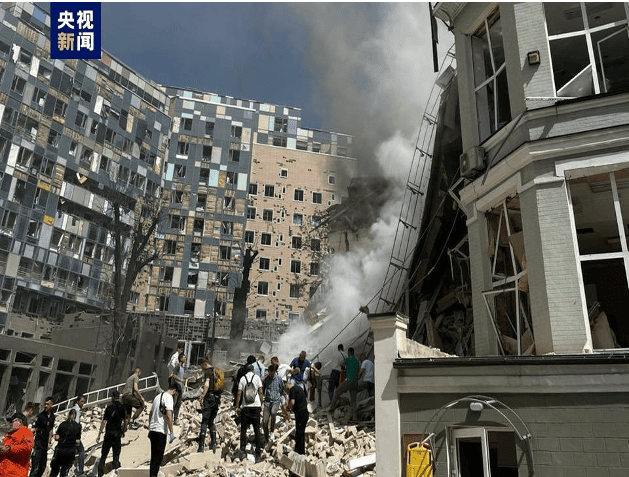
The Ukrainian presidential office said on July 8 local time that Russia's large-scale attacks on many parts of Ukraine have killed 36 people and injured 140 others. According to the Ukrainian State Emergency Service, a total of 619 rescue workers and 132 equipment participated in the rescue work across Ukraine that day. Ukrainian President Zelensky said on social media on the 8th that Russia launched more than 40 missiles of various types at Ukraine that day. Residential buildings and infrastructure in many cities in Ukraine were damaged in varying degrees of attacks, and a children's hospital was destroyed. Rescue departments are currently conducting emergency rescue on the scene. The Russian Ministry of Defense issued a statement on the 8th local time saying that Ukrainian officials' claim that Russia used missiles to attack Ukrainian civilian facilities was untrue. The damage suffered by Kiev was caused by the fall of missiles launched by the city's air defense system.